Imagine: there’s a $100 bill lying on the ground. You see it, bend down to pick it up, but someone else grabs it 0.3 seconds before you. This is exactly how cryptocurrency arbitrage works — where delays of even a few seconds mean missed profits. In this article, we’ll explore why PrimeARB AI’s cloud infrastructure with high-speed servers isn’t just a technical detail, but the key factor determining your profitability in futures arbitrage.

The Problem: When Seconds Cost Money and You’re Losing Them to Delays
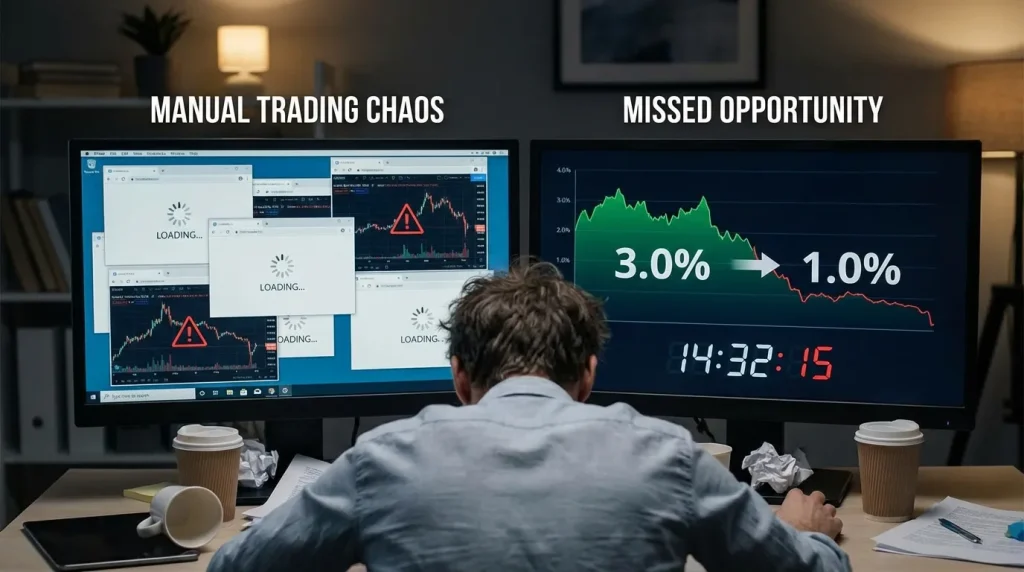
If you’ve ever tried trading cryptocurrency manually, you know this feeling: you found a great opportunity, opened the exchange, started placing an order — and the price has already moved. The difference between exchanges collapsed, the spread disappeared. You were too late.
But the problem isn’t just about the speed of your hands. Even if you were the fastest trader in the world, there are physical limitations:
Internet connection latency. The signal from your computer to the exchange server goes through dozens of nodes. On average, that’s 100-300 milliseconds — in arbitrage, that’s an eternity.
Human factor. While you see a 3% spread on one exchange, check the second one, calculate position size, enter the order — 5-15 seconds pass. During this time, professional arbitrage bots have already opened and closed positions 10 times.
Web interface limitations. Exchange websites aren’t optimized for high-frequency trading. Price updates lag, buttons load slowly, interfaces freeze under load.
Inability to execute simultaneously. In arbitrage, it’s critically important to open positions on both exchanges at the same time. If you opened a long on Binance and 3 seconds later tried to open a short on Bybit — the price has already changed. You bear slippage risk, which can completely eat up your profit.
The result? Most retail traders see arbitrage opportunities after the fact — when the spread has already closed. They work with delayed data, trade through slow interfaces, and compete with professional algorithms that execute orders in milliseconds.
This is why manual arbitrage is a survival game where 95% of participants lose to machines.
Education: How Arbitrage Windows Emerge and Why They’re Instantaneous
To understand why speed is critical, let’s examine how price differences between exchanges arise in the first place.
The Mechanism of Spread Formation
Cryptocurrency exchanges aren’t a single global market, but separate trading platforms with their own participants, algorithms, and liquidity. Imagine Bitcoin trading simultaneously in 8 different “stores”:
- On Binance — $50,000 (many buyers from Europe)
- On Bybit — $51,500 (panic sellers in Asia)
- On MEXC — $50,200 (less liquidity)
This difference occurs for several reasons:
- Technical delays. News breaks on Reuters — Asian exchanges (Bybit, Bitget) react 2-5 seconds faster than European ones (Binance). The price on Bybit shoots up to $51,500, while Binance is still at $50,000. This creates an “arbitrage window” — a time interval when you can buy cheaper on one exchange and sell more expensive on another.
- Liquidity differences. Major exchanges like Binance have millions of orders in the order book — prices are stable. On smaller exchanges (BingX, WEEX), one large $100,000 order can move the price by 1-2%. Market makers work independently on each platform, creating temporary discrepancies.
- Regional peculiarities. During regulatory news in the US, American traders massively sell on some exchanges, while Asian investors buy on others. This demand difference creates a spread.
Speed of Spread Collapse
But here’s what’s important: these windows exist for anywhere from a few seconds to a few minutes. Why so quickly?
Because professional arbitrageurs — large funds, market makers, algorithmic systems — constantly scan the market. As soon as a spread appears, they instantly:
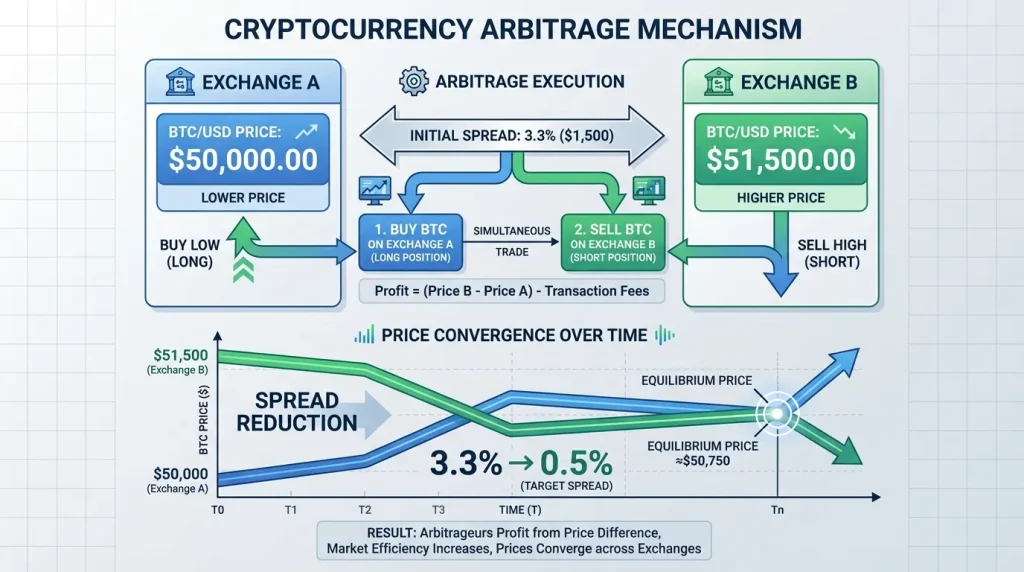
- Buy on the exchange with the low price (Binance: $50,000)
- Sell on the exchange with the high price (Bybit: $51,500)
- The spread begins to narrow — prices equalize to $50,750
The entire process takes 30-120 seconds. If your system receives data with a 5-second delay and places an order in 3 seconds — you’re late. The spread is already 1%, not 3%. Your potential profit of $1,500 turned into $500, and after commissions ($200) only $300 remains.
Arbitrage isn’t a “buy and hold” strategy. It’s a speed race where the winner is whoever picks up that $100 from the ground first.
Solution: PrimeARB AI Cloud Infrastructure — How Technology Turns Speed Into Money
Now imagine you have a robot that:
- Isn’t at your home with 150 ms ping, but on a dedicated server in a data center right next to the exchanges (3-15 ms ping)
- Doesn’t look at one screen, but simultaneously monitors 8 exchanges via API every second
- Doesn’t think or hesitate, but executes orders in 50-100 milliseconds on both exchanges in parallel
- Works 24/7 without breaks while you sleep, eat, or work
This is exactly how PrimeARB AI’s cloud infrastructure works.
What Are Dedicated High-Speed Servers?
PrimeARB AI doesn’t run on your home computer. The system operates on professional cloud servers with three critical parameters:
- Minimal ping to exchanges (3-30 ms)
PrimeARB servers are physically located in data centers near the infrastructure of major exchanges:
- For Binance, Bybit, OKX — servers in Singapore and Tokyo (Asia)
- For Gate.io, Bitget, MEXC — servers in Hong Kong and Seoul
- For BingX, WEEX — geographically distributed nodes
Result: latency is 3-15 milliseconds instead of your home’s 100-300 ms. It’s like the difference between Formula 1 and a bicycle.
- API connection directly to exchange trading engines
PrimeARB doesn’t use exchange web interfaces — the system connects via API (Application Programming Interface) directly to trading servers. This means:
- No page loading delays — data arrives in “raw” form (JSON format) instantly
- No visual elements — only numbers: price, volume, order book depth
- Parallel execution — the system can simultaneously send orders to 8 exchanges in one cycle
Example: you see a 3.2% spread on the ZEC/USDT pair between Bybit ($75.50) and Bitget ($78.00).
- Your option: Open Bybit → go to futures section → find ZEC/USDT → enter amount → confirm → switch to Bitget → repeat the process. Time: 15-20 seconds.
- PrimeARB AI: Screener detected spread → analyzed liquidity in 0.05 sec → sent API commands to both exchanges in 0.1 sec → positions opened simultaneously. Time: 0.15 seconds (150 milliseconds).
- High-speed screener processing 1000+ trading pairs per second

The PrimeARB AI system doesn’t just look at one asset. It constantly analyzes all liquid futures pairs on 8 exchanges:
- BTC/USDT, ETH/USDT (top assets)
- BNB, SOL, XRP, ADA, DOGE (high liquidity)
- Popular altcoins from top-50 by market cap
Every second, the screener:
- Receives price data via WebSocket API (constant data stream without delays)
- Calculates the spread for each pair between all exchanges (e.g., BTC on Binance vs Bybit, Binance vs MEXC, Bybit vs Gate.io, etc.)
- Filters only pairs with a spread of 3% and above (minimum threshold for profitability)
- Evaluates additional factors: liquidity (is there enough volume in the order book), volatility (isn’t it too risky), convergence history (how quickly prices usually equalize)
- Forms a signal and sends orders
All this happens automatically, without human participation, in fractions of a second.
How This Affects Your Profit: Real Example
Let’s break down a specific trade from PrimeARB AI statistics:
Pair: ZEC/USDT (Zcash)
Exchange A (Bybit): Price $75.50 (opened long — buy)
Exchange B (Bitget): Price $78.00 (opened short — sell)
Initial spread: 3.3% ($2.50 difference)
Position size: $3,000 on each exchange (total $6,000 at work)
Scenario 1: Manual trading (15-second delay)
You saw the 3.3% spread. While you were opening Bybit, entering the order, switching to Bitget — 15 seconds passed. During this time:
- Price on Bybit rose to $76.00 (+0.66%)
- Price on Bitget fell to $77.50 (-0.64%)
- New spread: 1.94% ($1.50 instead of $2.50)
Your profit: $1.50 × $3,000 / $75.50 = $59.60 (before deducting $20 commissions) = $39.60 net
Scenario 2: PrimeARB AI (0.15-second delay)
The system detected the 3.3% spread and opened positions in 150 milliseconds:
- Long on Bybit at $75.50
- Short on Bitget at $78.00
- Spread locked: 3.3%
After 48 hours, prices converged to a common level of $76.80:
- On Bybit: bought at $75.50, sold at $76.80 → profit +$1.30 × ($3,000/$75.50) = +$51.66
- On Bitget: sold at $78.00, bought at $76.80 → profit +$1.20 × ($3,000/$78.00) = +$46.15
- Total profit: $51.66 + $46.15 = $97.81
- After commissions (0.05% × 4 operations × $6,000 = $12): $85.81 net
Difference: $85.81 (bot) vs $39.60 (manual) = +116% more profit thanks to execution speed.
And this is just one trade. PrimeARB AI can perform 5-10 such operations per week.
Additional Benefits of Cloud Infrastructure
- Fault tolerance and backup channels
What if your home internet goes down? Or your computer freezes?
PrimeARB AI runs on cloud servers with:
- Backup communication channels (multiple internet providers)
- Automatic reconnection during failures
- Stop-loss orders set on exchanges (even if connection with PrimeARB is lost, the exchange will close the position itself at critical loss)
Your funds are protected regardless of whether your home internet is working.
- 24/7 operation without human participation
Arbitrage opportunities arise at any time — at 3 AM when you’re sleeping, on weekends when you’re resting. The cloud system:
- Doesn’t sleep, rest, or get distracted
- Doesn’t experience emotions (fear, greed, doubt)
- Doesn’t make input errors (wrong volume, incorrect price)
You simply configure the parameters once — and the system works autonomously.
- Scalability: from 2 to 8 exchanges without additional effort
Imagine you decided to trade manually on 8 exchanges. You would need to:
- Register on each one (KYC verification × 8)
- Create API keys on each one (security setup × 8)
- Manually distribute capital between exchanges
- Constantly switch between 8 browser tabs
PrimeARB AI does this automatically:
- You deposit to a single account in the system
- PrimeARB automatically creates sub-accounts on exchanges on your behalf (using the company’s internal API keys)
- Capital is distributed optimally between exchanges depending on arbitrage opportunities
- You control everything through a single interface
This isn’t just convenience — it’s a competitive advantage. The more exchanges you cover, the more arbitrage pairs are available.
Social Proof: Numbers Don’t Lie
PrimeARB AI’s cloud infrastructure isn’t just a marketing promise. Here are statistics confirming effectiveness:
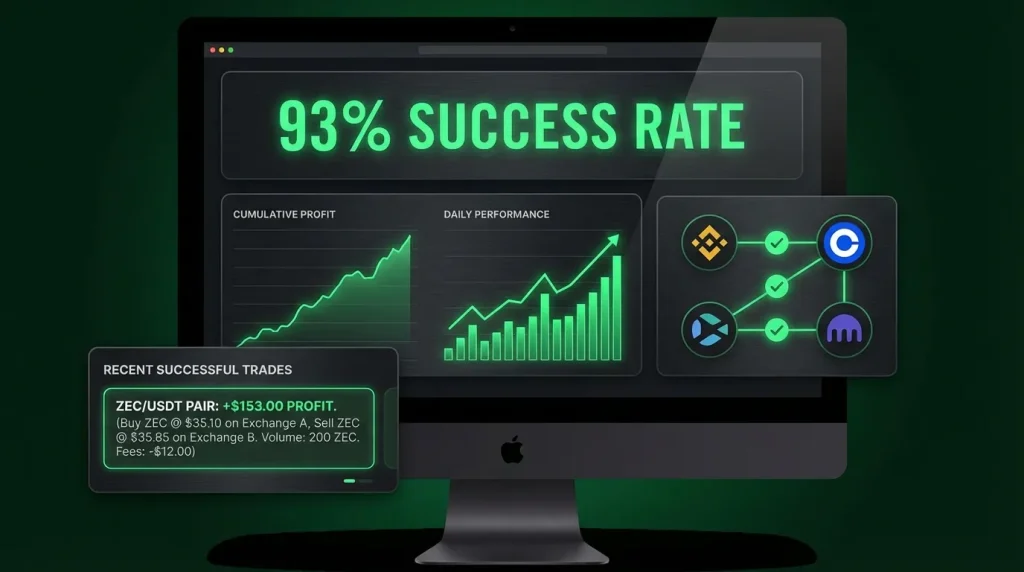
93% successful trades. Of all closed arbitrage positions, 93% have positive mathematical expectation. This means the system only enters trades when the probability of success is maximum.
Real case: During strong decorrelation on the ZEC/USDT pair on Bybit and Bitget exchanges, the spread reached 7%. The system:
- Opened long on Bybit
- Opened short on Bitget
- Waited for price convergence
- Result: On Bybit earned +$210, on Bitget -$57 → Net profit: $153 (7% spread minus commissions and partial loss on one side)
This isn’t an isolated case — such opportunities arise 5-10 times per week in aggressive trading mode.
Professional arbitrage funds (e.g., Jump Trading, Jane Street) target annual returns of 30-60%. PrimeARB AI, using similar technology, makes this strategy accessible to retail investors.
Time to first trade: Usually the first arbitrage position opens within 24-48 hours after system activation (depends on market conditions and volatility).
Addressing Objections: What If?
“This isn’t a get-rich-quick scheme?”
Absolutely correct — this is not a get-rich-quick scheme. PrimeARB AI is a professional tool for systematic earnings with controlled risk.
Realistic return expectations:
- Conservative mode (30-50% of deposit at work): 3-8% per month
- Balanced mode (60-70% of deposit): 8-15% per month
- Aggressive mode (80-90% of deposit): 15-25% per month
Annual return with reinvestment: 50-150%. But it’s important to understand:
- Past returns don’t guarantee future results
- There are months with zero or small negative returns
- This isn’t “10% per day” — such promises are signs of fraud
“What if the internet goes down during a trade?”
Multi-level protection:
Level 1: Positions remain open on exchanges — they won’t disappear when connection is lost.
Level 2: Stop-loss orders are set directly on the exchanges (not in the program). Even if connection with PrimeARB is lost, the exchange will close the position itself at critical loss.
Level 3: Automatic reconnection through backup channels.
Level 4: You’ll receive a notification about problems and can manually check positions through exchange web interfaces.
“How much capital is needed to start?”
Minimum thresholds:
- Technical minimum: $500-1000 (with limitations — trading on 2-3 exchanges)
- Recommended start: $3,000-5,000 (optimal diversification across 5-6 exchanges)
- Comfortable level: $10,000+ (full coverage of all 8 exchanges, 10-15 simultaneous positions)
Advice: start with an amount you’re willing to invest without emotional stress. Better $2,000 with a cool head than $10,000 in panic during the first temporary drawdown.
“Is this safe? Where is my money stored?”
Critically important:
- Your funds remain on your exchange accounts (Binance, Bybit, MEXC, etc.)
- PrimeARB AI doesn’t store client funds — the system only manages trading via API
- API keys are created without withdrawal rights (only trading and balance reading rights)
- You can revoke API keys at any time and stop the system
Additional protection:
- IP-whitelist (system only works from approved IP addresses)
- KYC verification (compliance with international AML/KYC requirements)
- Two-factor authentication (2FA) for personal account login
Call to Action: How to Start Earning on Speed
If you’ve read this far, you understand: in arbitrage, speed isn’t just convenience, but the direct difference between profit and missed opportunity.
Four simple steps to start:
- Registration → Go to the official PrimeARB AI website, create an account (email + strong password). Time: 3-5 minutes.
- Verification (KYC) → Upload documents to confirm identity (passport/ID, selfie, optionally — address proof). Processing: from a few hours to 1-2 business days.
- Deposit → Deposit capital to the unified account ($500-$10,000 depending on goals). The system will automatically create sub-accounts on exchanges and distribute funds.
- Parameter setup → Choose operating mode:
- Conservative (30-50% of deposit) — for beginners
- Balanced (60-70%) — optimal choice
- Aggressive (80-90%) — for experienced investors
- Launch → Click “Activate trading” — the cloud system will start working automatically. The first trade usually opens within 24-48 hours.
Starting tip: Begin with conservative mode (30-50% of deposit at work). This will give you psychological comfort — half the capital is always in reserve for margin requirements, and you calmly observe the system’s operation.
After 2-4 weeks, when you understand the mechanics and see results, you can adjust parameters toward more aggressive profitability.
Technology vs. Emotions
PrimeARB AI’s cloud infrastructure isn’t just a set of servers. It’s a competitive advantage that turns a physically impossible task for humans (monitoring 8 exchanges 24/7 with order execution in milliseconds) into an automated flow of arbitrage trades.
While other traders watch charts, try to guess Bitcoin’s direction, and lose money on emotional decisions, the PrimeARB system earns on mathematics and speed:
✅ Market neutrality — doesn’t matter if Bitcoin rises or falls
✅ Positive mathematical expectation — 93% successful trades
✅ 24/7 automation — the robot works while you sleep
✅ Security — funds on your exchange accounts, API without withdrawal rights
✅ Simplicity — one deposit, everything else automatic
Arbitrage isn’t guessing the future. It’s picking up $100 from the ground faster than competitors. And in this race, the winner is whoever has the fastest infrastructure.
Ready to stop being late for profitable trades? Start with PrimeARB AI today.
Important: Cryptocurrency investments carry risks. Past returns don’t guarantee future results. Start with capital you’re willing to invest without emotional stress. Make sure you understand arbitrage mechanics and risk management settings before launching automated trading.
Information about the author

As head of the PrimeARB AI platform, Nathan applies his many years of experience in financial markets and technology to create an innovative AI system for futures arbitrage. His vision is to make professional trading strategies accessible to a wide range of investors through automation and artificial intelligence.
Nathan Michaud is a recognized professional trader with over 20 years of experience trading on the NYSE and Nasdaq exchanges in the United States. Starting his trading career in 2003 as a student at the University of New Hampshire – Whittemore School of Business and Economics, Nathan quickly turned his passion for financial markets into a successful career.
