
When Hype Meets Reality
Have you ever seen an ad with the bold tagline “Break the Bank with Bitcoin overnight” — and believed it for just a second? If so, you’re not alone. The crypto market is flooded with platforms that sell dreams instead of strategies. But there is a fundamental difference between a system backed by mathematics, statistics, and transparent mechanics, and a project that thrives on hype and beautiful promises. In this article, we’ll break down why 93% successful trades based on a real mathematical edge is incomparably more valuable than any loud slogan about “breaking the bank” — and along the way, we’ll explain how futures arbitrage works, one of the most professional approaches to earning in the crypto market.
The Problem: Why Most Beginners Lose Money in Crypto
Picture a typical scenario: someone hears that their friend “made a killing” on Bitcoin. They sign up on an exchange, buy a few coins — and the daily stress begins. Monitoring charts at 3 a.m. Panic at every dip. Euphoria at every pump. And at some point — an impulsive trade that wipes out a month’s salary.

This isn’t the exception. This is the rule. Statistics show that over 70% of retail traders lose money in volatile markets. The reasons are well-known:
- Emotional decision-making instead of a systematic approach
- No market-neutral position: the entire bet is placed on price going up or down
- Physical impossibility of monitoring the market 24/7 — and crypto never sleeps
- Technical barriers: registering on dozens of exchanges, configuring API keys, managing capital allocation
The market immediately responds to this demand — and here is where the trap begins. Platforms like BitcoinBankBreaker (and their countless clones) sell the illusion of effortless wealth: slick dashboards, promises of “10% a day,” dubious testimonials, and mechanics that nobody properly explains. The outcome is predictable: funds disappear, support goes dark, and the platform rebrands under a new name to find a fresh audience.
How do you tell a real tool from hype? The answer is simple: look at the mathematics, the mechanics, and the transparency — not the promises.
Educational Block: What Is Futures Arbitrage and Why Does It Work?
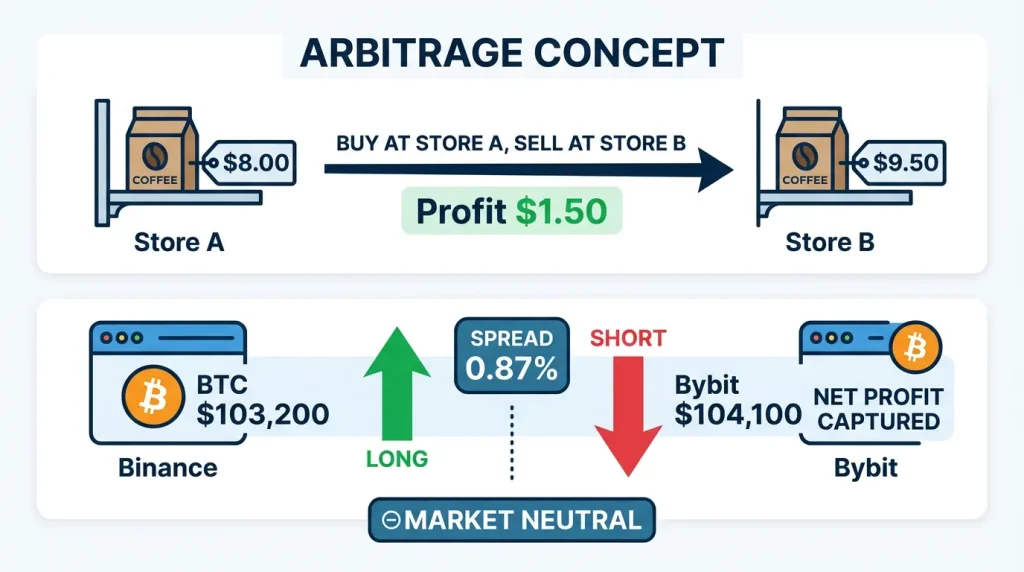
Let’s break this down in plain terms, without complex jargon.
A Simple Analogy
Imagine this: a box of coffee costs $8 at one supermarket and $9.50 at the one next door. If you buy at the first and sell at the second, you earn $1.50 on the price difference. That is arbitrage in its purest form. You don’t need to guess whether coffee will get more expensive or cheaper. You profit from an existing inefficiency, right now.
The same logic applies between cryptocurrency exchanges. Bitcoin might be trading at $103,200 on Binance and $104,100 on Bybit. The difference — $900, or roughly 0.87% spread. Futures arbitrage means simultaneously opening a long (buy) position on one exchange and a short (sell) position on the other. When the prices converge, both positions are closed, and the difference stays in your pocket.
Why Do These Price Differences Even Exist?
This is a fundamental question. If markets were perfectly efficient, price discrepancies wouldn’t exist. But in reality:
Technical latency. Prices update with micro-delays on different exchanges. During high volatility, Asian exchanges may react to news faster than European ones — creating a temporary price gap.
Liquidity differences. Billions of dollars trade on Binance every day — a single order barely moves the price. On a smaller exchange, one large player can create a noticeable gap.
Regional demand. During a panic in one region, more sellers appear there, which locally depresses the price. In another region, the price stays higher at the same moment.
Independent market-maker algorithms. Each exchange has its own liquidity providers operating autonomously — and they continuously create temporary divergences.
The key insight: these discrepancies are short-lived but arise constantly and repeatedly. This is precisely why professional arbitrage funds have consistently targeted 30–60% annual returns for years — not from market direction, but from harvesting these inefficiencies.
The Core Advantage Over Speculation
Ordinary trading is a directional bet. You buy ETH hoping it will go up. If the market moves against you — you take a loss. That’s speculation, where you compete against bank algorithms, hedge funds, and thousands of professionals.
Arbitrage is a market-neutral strategy. It doesn’t matter whether Bitcoin rises 30% or falls 20% — all that matters is the price difference between two exchanges right now. If Bitcoin drops simultaneously on both Binance and Bybit, the long and short positions move in opposite directions and cancel each other out. You are not betting on an outcome — you are harvesting inefficiency.
The Solution — PrimeARB AI: How It Works in Practice
Now for the specifics. PrimeARB AI is an automated futures arbitrage platform that operates simultaneously across 8 major exchanges: Binance, Bybit, MEXC, Gate.io, Bitget, BingX, OKX, and WEEX.
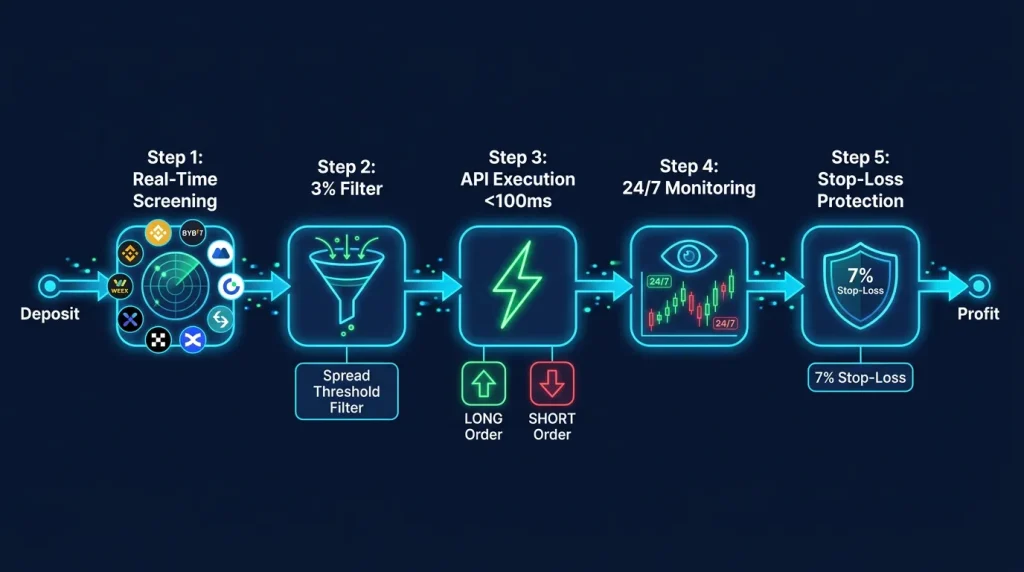
The Technical Trade Cycle
The system follows a precise, fully automated algorithm at every step:
- Real-time screening. Every second, the built-in screener pulls data via the APIs of all 8 exchanges — millions of data points per minute. The system calculates the spread for every trading pair across all possible exchange combinations.
- Parameter-based filtering. A trade is only opened when a specific set of conditions is met: minimum spread of 3%, sufficient liquidity, and acceptable order book depth. The 3% threshold exists for a precise reason: after paying exchange fees (0.05% taker × 4 operations = 0.20%), the trade must still be profitable.
- Lightning-fast API execution. When conditions are met, the system simultaneously opens a long on one exchange and a short on the other. Latency is under 100 milliseconds. A delay of even one second could mean the spread has already collapsed.
- Monitoring and position closure. The system tracks positions and closes them when prices on the two exchanges converge. All of this happens without your involvement — 24 hours a day, 7 days a week.
- Stop-loss protection. In rare cases (approximately 7% of trades), the spread doesn’t converge — it widens instead. For these situations, stop-losses are placed directly on the exchanges. They trigger even if your internet connection drops. This is the fundamental risk management layer.
Why You Don’t Need to Register on 8 Exchanges Yourself
This is one of the biggest barriers for beginners: manually running cross-exchange arbitrage means completing KYC on each exchange, creating and configuring API keys, and distributing capital — all on your own. Most people give up at this stage.
PrimeARB AI solves this elegantly: you make a single deposit, and the system automatically creates sub-accounts on partner exchanges, distributes capital optimally, and manages it through built-in API integrations. You control everything through a single interface — with zero technical headache.
Security: Your Funds Stay on the Exchanges
It’s important to be crystal clear about this upfront. PrimeARB AI does not hold your funds — they remain on regulated cryptocurrency exchanges in your accounts. API keys are configured without withdrawal permissions: the system can trade, but it cannot move a single dollar out of your account. This is a technical restriction, not just a promise.
Real Numbers: What the Statistics Show
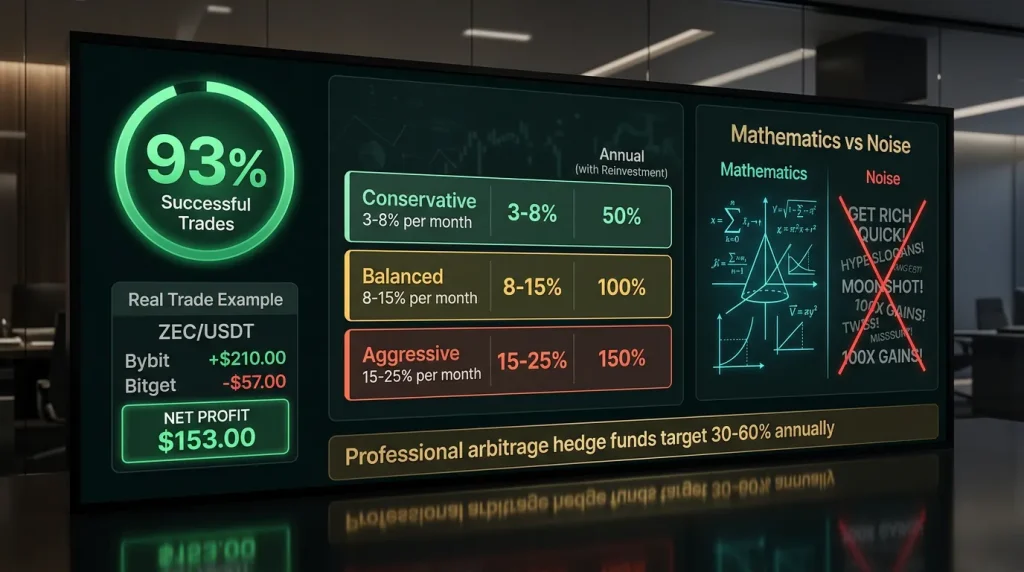
Enough theory — let’s look at the numbers.
93% of PrimeARB AI trades close with a positive result. This isn’t a marketing claim — it is a statistic rooted in the concept of positive expected value. The system only opens trades when the spread is large enough to remain profitable after all fees.
A real trade example: ZEC/USDT. During a sharp de-correlation of the ZEC/USDT pair across Bybit and Bitget, the spread reached 7%. The system opened a long on Bybit and a short on Bitget. As time passed, prices on both exchanges converged. Result: the Bybit leg returned $210, while the Bitget leg closed at a loss of $57 (this is expected — the short went against the directional move). Net profit: $210 − $57 = $153 from a single arbitrage construction.
This isn’t luck — it’s mathematics. When the spread is 7% and the loss on the short leg is covered by the gain on the long leg, you capture the pure difference.
Realistic return expectations:
| Mode | Deposit Deployed | Expected Monthly Return |
| Conservative | 30–50% | 3–8% per month |
| Balanced | 60–70% | 8–15% per month |
| Aggressive | 80–90% | 15–25% per month |
| Annual (with reinvestment) | — | 50–150% |
For context: professional arbitrage hedge funds target 30–60% annually — and are regarded as some of the strongest performers in the industry by risk-adjusted return metrics.
How to Get Started — Concrete Steps
If you’ve read this far and want to try — here is a clear, no-fluff action plan:
- Step 1 — Registration. Visit the official PrimeARB AI website and create an account with a real email address. Enable two-factor authentication immediately — this is baseline security hygiene.
- Step 2 — KYC Verification. Complete identity verification (passport + selfie with document). The upload takes 10–15 minutes, and processing takes anywhere from a few hours to 2 business days. Verification is mandatory — it ensures compliance with international AML/KYC requirements and protects your account.
- Step 3 — Deposit. Fund your account in USDT or another supported cryptocurrency. The system will automatically create sub-accounts on partner exchanges and distribute capital across them. No manual configuration required on your end.
- Step 4 — Choose a Mode. Start with Conservative mode: 30–50% of the deposit deployed, with a target monthly return of 3–8%. This lets you observe how the system performs with minimal exposure and get your first results within 24–48 hours of activation.
- Step 5 — Monitor. Track statistics through the unified dashboard. Once you’re confident in the consistency of results, you can move to Balanced mode or increase your capital allocation.
In Closing: Mathematics vs. Noise
Let’s return to the original question: PrimeARB AI vs BitcoinBankBreaker — what is the fundamental difference?
BitcoinBankBreaker and platforms like it sell an emotion — greed, fear of missing out, the desire for quick money. Their mechanics are opaque, their promises are unverifiable, and risk management is either absent or buried in two lines of fine print.
PrimeARB AI offers a system — with transparent mechanics, real trading operations on regulated exchanges, verifiable statistics, and honest disclosures about risk. This is not a promise to “break the bank.” It is a tool that helps you systematically harvest market inefficiencies — the same way professional arbitrage funds have done it for decades.
93% successful trades is not a slogan. It is the result of a mathematically calibrated strategy with positive expected value. That is why arbitrage remains one of the very few strategies where the investor profits not by predicting the market, but by working with its structure.
Disclaimer: trading cryptocurrency derivatives involves significant risk. Past performance does not guarantee future results. Only invest funds whose loss would not adversely affect your financial wellbeing.
Information about the author

As head of the PrimeARB AI platform, Nathan applies his many years of experience in financial markets and technology to create an innovative AI system for futures arbitrage. His vision is to make professional trading strategies accessible to a wide range of investors through automation and artificial intelligence.
Nathan Michaud is a recognized professional trader with over 20 years of experience trading on the NYSE and Nasdaq exchanges in the United States. Starting his trading career in 2003 as a student at the University of New Hampshire – Whittemore School of Business and Economics, Nathan quickly turned his passion for financial markets into a successful career.
