While most crypto investors sit in front of charts trying to guess Bitcoin’s next move, there’s a completely different approach to earning — one that doesn’t depend on whether the market rises or falls. Imagine: you earn 8-15% per month regardless of market direction, without experiencing emotional burnout from constantly monitoring charts 24/7. Sounds too good? Welcome to the world of futures arbitrage.

The Problem No One Talks About
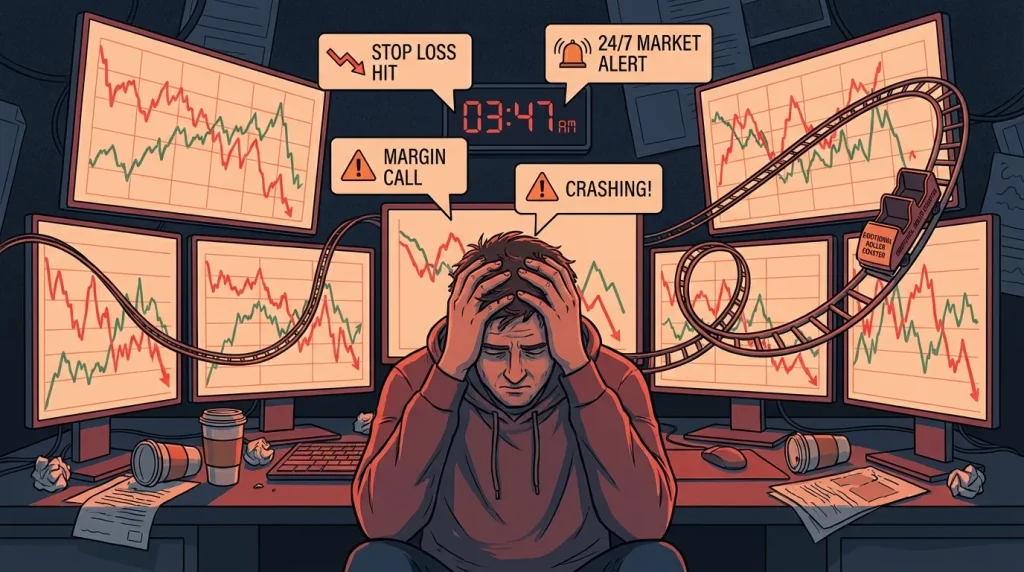
If you’ve ever traded cryptocurrencies, you know this feeling. You buy Bitcoin at $50,000, hoping for growth. The price rises to $52,000 — euphoria! Then it drops to $48,000 — panic. You sell emotionally, locking in a loss. The next day Bitcoin returns to $51,000. Sound familiar?
The main problem with traditional trading is psychology and directional risk. You’re betting that the price will move in a certain direction, competing with millions of other traders, professional algorithms, and market whales. The statistics are merciless: according to various studies, about 70-80% of retail traders lose money in the long run.
But there are other pain points too:
- Emotional burnout: The cryptocurrency market operates 24/7. While you sleep, your positions can crash 20%. Constant anxiety destroys health and relationships.
- Technical complexity: Try manually tracking prices on eight exchanges simultaneously, calculating differences, accounting for fees, quickly placing orders… By the time you’ve done all this, the opportunity has vanished.
- Volatility as enemy: Sharp price swings destroy stop-losses and turn small losses into catastrophic ones. One news item from regulators can wipe out a month’s profits.
What if there was a way to earn from cryptocurrencies where you don’t need to guess market direction, and volatility becomes your ally rather than your enemy?
Futures Arbitrage: How to Profit from Market Inefficiency
Let’s start with a simple analogy. Imagine you discovered that the same iPhone 15 sells in Store A for $700 and in Store B for $750. You simultaneously buy the phone in Store A and sell it (having pre-arranged delivery) in Store B. The $50 difference minus delivery costs is your profit. And you absolutely don’t care whether the iPhone gets more expensive or cheaper tomorrow. You earned from the price difference between selling points.
Futures arbitrage works exactly the same way, but on cryptocurrency exchanges.
Why Do Price Differences Even Exist?
This may seem strange: how can the same cryptocurrency trade at different prices in an era of high-speed internet? But there are several reasons:
- Technical delays: Prices update with micro-delays. An exchange in Asia might react to news seconds faster than a European one. In crypto, seconds matter.
- Liquidity differences: On a large exchange like Binance, there may be millions of dollars in the order book with stable prices. On a smaller exchange, one large $100,000 order can shift the price by 2-3%.
- Regional peculiarities: During panic moments in one region (for example, after news about crypto bans), there may be an excess of sellers there, while another region has buyers. This creates a temporary price imbalance.
- Trading bot behavior: Market maker algorithms operate independently on each exchange. Sometimes their actions aren’t synchronized, creating temporary discrepancies.
Important to understand: these discrepancies are short-term — usually from a few seconds to several hours. Professional arbitrageurs (including major funds managing hundreds of millions of dollars) constantly level them out. But they arise again and again, especially during high volatility periods.
How Does It Work in Practice?
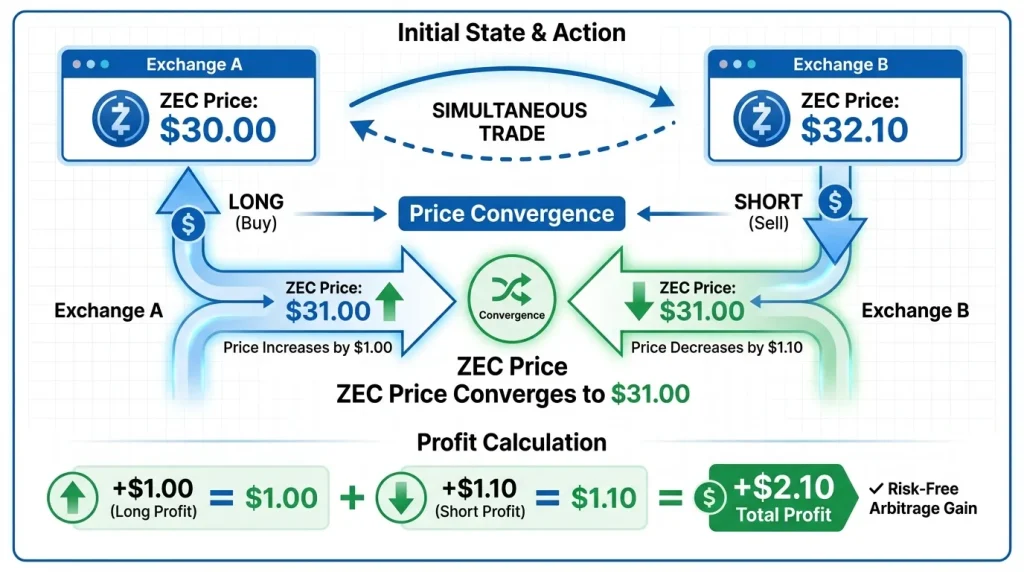
Let’s say at a certain moment:
- Binance: ZEC/USDT trades at $30.00 (futures)
- Bitget: ZEC/USDT trades at $32.10 (futures)
The difference is $2.10 or 7% spread. The arbitrage strategy:
- Open LONG (buy) on Binance at $30.00
- Simultaneously open SHORT (sell) on Bitget at $32.10
- Wait for price convergence: After a few hours, prices level out, for example, at $31.00
- Close both positions:
- On Binance, sell at $31.00 → profit $1.00 per unit
- On Bitget, buy back at $31.00 → profit $1.10 per unit
- Total profit: $2.10 minus fees
A real example from PrimeARB AI practice: on the ZEC/USDT pair, the spread reached 7% between Bybit and Bitget. A long was opened on Bybit, a short on Bitget. After price convergence, the Bybit trade brought $210, Bitget -$57. Final profit: $153.
Key difference from speculation: You don’t care whether ZEC went up or down. If the price had fallen to $28, you would have lost $2 on the Binance long but earned $4.10 on the Bitget short — total profit still around $2 (considering the initial spread). This is called a market-neutral strategy.
Positive Mathematical Expectation
Sounds like professional jargon, but the idea is simple. If you flip a coin where heads pays you $11 and tails you pay $10, you have positive mathematical expectation. Do this 100 times — and you’re guaranteed to profit.
Arbitrage has a similar principle: you only enter a trade when the spread is large enough (usually from 3%) to cover all fees (opening/closing positions on two exchanges = about 0.20% total) and leave a profit. PrimeARB AI statistics show: 93% of trades close with positive results.
Even if 7% of trades require closing at stop-loss with a small loss, the overall balance of a series of trades is positive. Professional arbitrage funds target 30-60% annual returns precisely because of this principle.
The Solution: PrimeARB AI — Artificial Intelligence as Arbitrageur
Now imagine: you try to do all this manually. You need to simultaneously monitor prices on 8 exchanges (Binance, Bybit, MEXC, Gate.io, Bitget, BingX, OKX, WEEX), calculate spreads for hundreds of trading pairs, account for liquidity and order book depth, instantly place orders… By the time you open the third browser window, the spread has already disappeared.
This is precisely why 99% of successful arbitrageurs are robots.
How Does PrimeARB AI Work?
PrimeARB AI is a fully automated system that does all the heavy lifting for you:
- High-Speed Scanner (Opportunity Scout)
Every second, the program receives data via API from eight exchanges:
- Monitors futures contract prices in real-time
- Calculates spreads for all available trading pairs (BTC, ETH, SOL, XRP, and dozens of others)
- Filters opportunities: minimum 3% spread, sufficient liquidity, historical convergence data
- Analyzes order book depth to avoid slippage
Speed is critical: a delay of even 5-10 seconds means the spread can collapse. API trading operates with latency of less than 100 milliseconds versus several seconds of manual input.
- Automatic Position Opening
When all conditions are met, the system:
- Simultaneously opens LONG on the exchange with the low price
- Opens SHORT on the exchange with the high price
- Sets stop-loss orders directly on the exchanges (not in the program!) to protect against emergency situations
- All this happens in fractions of a second, without emotions or hesitation
- Smart Position Closing
The system doesn’t just wait for the spread to become zero. It:
- Analyzes the speed of price convergence
- Closes positions when reaching the target level (usually when spread narrows to 0.3-0.5%)
- Applies dynamic adjustment: if convergence stalls, closes earlier, freeing capital for new opportunities
- Protects with stop-losses: if the spread doesn’t narrow but increases (rare situation but possible during exchange technical failures), the position closes with controlled loss
Revolutionary Convenience: Single Deposit
Here’s where PrimeARB AI does what no competitor can. Normally, for arbitrage between exchanges, you need to:
- Register on each of the 8 exchanges
- Pass KYC verification on each
- Create and configure API keys on each
- Manually distribute capital between exchanges
- Constantly rebalance funds between exchanges
With PrimeARB AI it’s different:
- You deposit funds into a single account in the PrimeARB AI system
- The system automatically creates sub-accounts on partner exchanges, registered to you
- Capital is automatically distributed optimally between exchanges
- You control the process through a single interface — no eight browser tabs
It’s like the difference between buying stocks on 10 stock exchanges yourself and investing in an ETF that does everything for you.
Security: Your Money Stays with You
The most important question: “Won’t you run away with my money?” I understand the skepticism — the crypto industry is full of scams.
Here’s how security is structured:
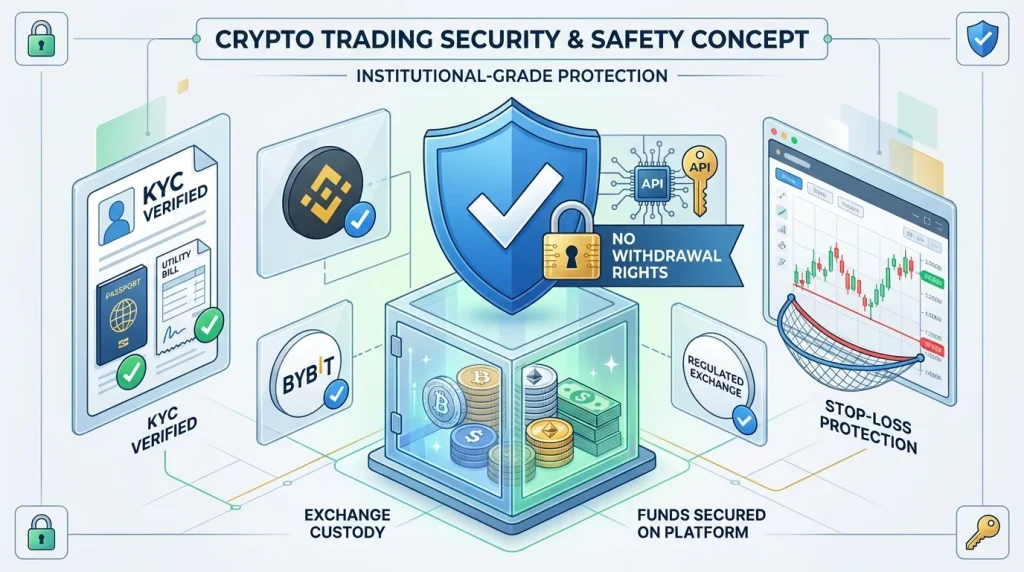
- API keys without withdrawal rights: The system only has access to trading and balance reading. Withdrawing funds from your exchange accounts via API is physically impossible.
- Funds remain on exchanges: PrimeARB AI doesn’t hold client money. Your capital is in your sub-accounts on regulated exchanges (Binance, Bybit, etc.).
- KYC verification: The system requires identity verification, complying with international AML/KYC standards and protecting against unauthorized access.
- Stop-losses on the exchange side: Even if connection to PrimeARB AI is completely lost (your internet disconnected, servers crashed), protective orders are set on the exchanges themselves and will continue to work.
- Transparency: You can at any moment log into the exchange directly via web interface and see all your positions, trade history, and balances.
Social Proof: It Works

Futures arbitrage isn’t a new concept. Professional trading funds have used this strategy for decades in traditional markets (stocks, commodities, currencies). With the emergence of cryptocurrencies and multiple exchanges, opportunities have become even more abundant.
PrimeARB AI Statistics:
- 93% of trades close with positive results
- Average returns in balanced mode: 8-15% per month
- System operates on 8 major exchanges with combined daily volume exceeding $50 billion
Real case: During strong price discrepancy on the ZEC/USDT pair between Bybit and Bitget exchanges, the spread reached 7%. The system automatically opened a long on Bybit and short on Bitget. After prices converged to a common level, the trade brought a net profit of $153 (including all fees).
Professional context: Major arbitrage hedge funds target 30-60% annual returns. PrimeARB AI makes this strategy accessible to retail investors with capital from $500, whereas professional funds typically require a minimum of $100,000-$1,000,000 to enter.
Dispelling Common Objections
“Is This a Get-Rich-Quick Scheme?”
No. PrimeARB AI is a tool for systematic earning with controlled risk. If someone promises you 10% per day or 300% per month — run, it’s fraud.
Realistic returns:
- Conservative mode (30-50% of deposit working): 3-8% per month
- Balanced mode (60-70% of deposit): 8-15% per month
- Aggressive mode (80-90% of deposit): 15-25% per month
This is more like conservative investing, but with potentially higher returns due to cryptocurrency market inefficiencies. Not every trade is profitable, there are months with zero returns, but over a year with reinvestment, 50-150% is realistic with proper risk management.
“What If the Internet Goes Down?”
Multi-level protection:
- Your positions remain open on exchanges (won’t disappear)
- Stop-loss orders are set on the exchange side — they’ll trigger even without connection to PrimeARB AI
- System uses automatic reconnection
- You’ll receive a notification and can manually manage positions through exchange apps
“How Much Capital Is Needed? What If I Only Have $500?”
Technical minimum is $500-1000, but with limitations: trading on 2-3 exchanges, fewer simultaneous positions, higher percentage risk.
Recommended start: $3000-5000. This allows:
- Distributing capital across 5-6 exchanges
- Holding 3-5 simultaneous positions
- Maintaining risk below 1% per trade
- Getting tangible returns in absolute values (15% of $5000 = $750 per month)
Comfortable operation: $10,000+ for full diversification across all 8 exchanges and maximum efficiency.
Important: start with capital whose loss you can survive without emotional stress. Better $2000 with a cool head than $10,000 in panic at the first drawdown.
“Is It Safe? Won’t I Be Scammed?”
Three levels of security:
- Technical: API without withdrawal rights, funds on regulated exchanges
- Legal: KYC verification, compliance with international standards
- Practical: You can always manually close positions through the exchange’s web interface
Risks exist (as with any investments), but they’re related to market factors (sharp spread increase, technical problems on exchanges), not “the company running away with money.”
How to Start: Step-by-Step Action Plan
If you’ve read this far and the idea resonates, here are concrete steps:
Step 1: Registration and Verification (30 minutes)
- Register on the official PrimeARB AI website
- Complete KYC verification (upload passport, selfie)
- Processing usually takes from several hours to 1-2 business days
Step 2: Deposit
- Fund the single account (USDT recommended for speed)
- System will automatically create sub-accounts on exchanges and distribute capital
Step 3: Parameter Settings (10 minutes)
- Choose operating mode (recommended to start with 50-60% of deposit)
- Minimum entry spread: 3% (don’t change without understanding)
- Risk per trade: 1% (conservative)
Step 4: Activation (1 click)
- Click “Activate Trading”
- System begins automatic opportunity search
- First trade usually opens within 24-48 hours (depends on market conditions)
Step 5: Monitoring and Optimization
- Check results 1-2 times per day (no need to sit 24/7)
- After 2-4 weeks, evaluate results and adjust parameters if necessary
- As confidence grows, you can increase the percentage of deployed deposit
Automation Against Emotions
Futures arbitrage isn’t a magic pill or instant wealth method. It’s a systematic approach to earning from structural market inefficiencies that professionals with tens of millions of dollars use.
PrimeARB AI makes this strategy accessible to ordinary investors by automating complex technical processes and removing the emotional factor. You don’t guess where Bitcoin will go. You don’t trade against whales. You simply pick up those “$100 bills from the ground” that others didn’t notice due to the technical complexity of the process.
Start with conservative mode, small capital, and observe. After a month, you’ll understand how it works. After three months, you’ll see statistically significant results. And after a year, arbitrage may become a stable part of your investment portfolio, generating income regardless of whether the crypto market rises or falls.
The financial world is changing. Those who adapt to new technologies earlier than others gain a competitive advantage. Artificial intelligence is already finding arbitrage opportunities in milliseconds. The only question is whether you’ll be among those who use these technologies or remain an observer.
Learn more about PrimeARB AI and start earning from price differences today.
Disclaimer: Cryptocurrency trading involves risks. Past performance does not guarantee future results. Only invest funds whose loss you can afford. This article is for informational purposes and is not investment advice.
Information about the author

As head of the PrimeARB AI platform, Nathan applies his many years of experience in financial markets and technology to create an innovative AI system for futures arbitrage. His vision is to make professional trading strategies accessible to a wide range of investors through automation and artificial intelligence.
Nathan Michaud is a recognized professional trader with over 20 years of experience trading on the NYSE and Nasdaq exchanges in the United States. Starting his trading career in 2003 as a student at the University of New Hampshire – Whittemore School of Business and Economics, Nathan quickly turned his passion for financial markets into a successful career.
