
When a “Trading Robot” Promises a Fortune — It’s Time to Be Suspicious
Picture this: you’ve just started learning about cryptocurrencies, you open your browser, and you see an ad — “DHL Bitcoin Era — an automatic robot earns thousands of dollars for you every day!” Sound familiar? This is exactly how most fraudulent schemes in the crypto industry look: flashy promises, zero transparency, and absolutely no explanation of how the system actually makes money.
But what if a real, automated strategy existed — one with clear mathematics, verifiable mechanics, and no promises of “10% per day”? That’s exactly what we’re going to break down today: an honest comparison between a murky “trading robot” and the transparent futures arbitrage platform, PrimeARB AI.
The Problem: A Crypto Beginner Is the Perfect Target

The crypto market attracts people with success stories — someone bought Bitcoin at $100 and is now a millionaire. But for most beginners, reality looks very different:
Volatility destroys deposits. Bitcoin can drop 30% in a week, and no “trading signals” will save you if you bought at the top. Manual trading demands constant attention to charts, the ability to read technical analysis, and nerves of steel. Most retail traders lose money precisely because of emotional decisions — buying on euphoria, selling in panic.
Emotional burnout is not a metaphor. Monitoring the market 24/7 is physically impossible, and crypto never takes a day off. People lie awake at night nervously checking prices, ruining their health and relationships — and still end up losing money.
“Trading robots” are a minefield for beginners. This is where platforms like DHL Bitcoin Era come in. A typical portrait of such services: bold promises (“earn $1,500 a day”), complete opacity of the algorithm (“our secret AI analyzes the market”), stock-photo testimonials, and aggressive managers demanding an “immediate minimum deposit.”
If a platform cannot explain how exactly it generates profit — that’s a massive red flag. Money doesn’t appear from thin air, and if the mechanism is opaque, chances are you’re funding someone else’s earnings, not your own.
Educational Block: What Is Futures Arbitrage and Why Does It Work?
Before comparing platforms, you need to understand the mechanics. This isn’t dry theory — it’s the foundation that separates a real strategy from a hollow promise.
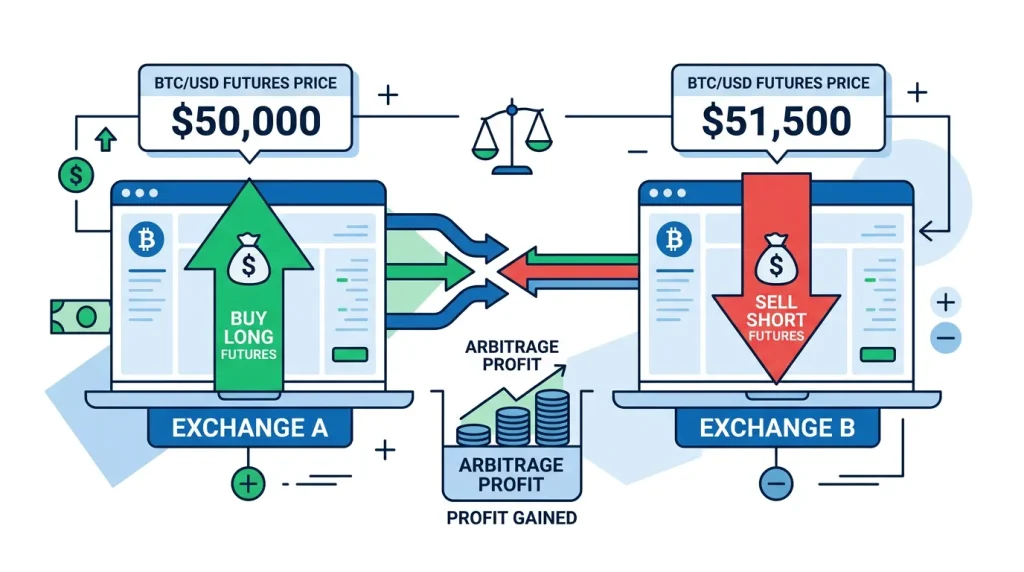
Arbitrage Explained in 2 Minutes
Imagine a simple situation: you notice that a bottle of water at the corner store costs $0.80, while the shop across the street sells it for $1.20. You buy a case at the cheaper place and sell it where the price is higher. The difference is your profit. That’s arbitrage in its simplest form.
The same thing happens on crypto exchanges, only faster and at a larger scale. Futures arbitrage is the profit earned from the price difference of the same asset (say, Bitcoin) between two exchanges — simultaneously.
A concrete example: Bitcoin is trading at $50,000 on Binance and $51,500 on Bybit. An arbitrageur simultaneously:
- Opens a long (buy) position on Binance at $50,000
- Opens a short (sell) position on Bybit at $51,500
A few hours later, prices converge — say, to $50,750 on both exchanges. Both positions are closed:
- On Binance: +$750 profit (bought at $50,000, sold at $50,750)
- On Bybit: −$750 loss (sold at $51,500, bought at $50,750)
Wait — isn’t that zero? No! The trader “collected” the original $1,500 spread, and both positions neutralised each other’s market exposure. After deducting commissions (approximately 0.20% for 4 operations), the net profit on this trade is around $1,300.
Why Do Price Differences Between Exchanges Exist?
Exchanges are independent markets. Each has its own user base, its own liquidity, and its own market-maker algorithms. When important news breaks in Asia, prices react there faster than on European platforms. A large order on a less liquid exchange can move the price by 1–3%. Regional demand creates temporary imbalances.
These discrepancies are short-lived — typically lasting from a few seconds to several hours. That’s precisely why arbitrage requires automation: a human simply cannot react fast enough while the window of opportunity is still open.
The Key Difference from Speculation
Regular trading is a bet on the direction of the market. You’re guessing whether Bitcoin will go up or down — competing against professional traders, quantitative funds, and algorithms with incomparably greater information and speed.
Arbitrage is a market-neutral strategy. It doesn’t matter which way Bitcoin moves. If it drops 20%, you lose on the long — but earn exactly as much on the short. Your profit depends solely on the convergence of the spread, not on predicting market direction.
This is why professional arbitrage funds consistently deliver 30–60% annually even during bear markets, when most traders are bleeding losses.
The Solution: How PrimeARB AI Works — Step by Step
PrimeARB AI is an automated futures arbitrage platform that executes the strategy described above without requiring your daily involvement. Let’s walk through the mechanics — honestly and in detail.
How the System Finds and Executes Trades
- Real-time screener. Every second, the algorithm receives futures price data from 8 exchanges — Binance, Bybit, MEXC, Gate.io, Bitget, BingX, OKX, and WEEX. That’s tens of thousands of data points per minute.
- Opportunity filtering. From that entire data stream, the system selects only pairs where the inter-exchange spread is at least 3%. This threshold was chosen mathematically: it guarantees that all commissions (4 × 0.05% taker = 0.20%) are covered while leaving a real net profit.
- Trade quality assessment. Finding a spread isn’t enough. The system also analyses order book depth, daily trading volume (minimum $10M per pair), historical convergence probability, and current volatility. Only when all parameters are green does the signal pass to the execution module.
- Lightning-fast execution. Through exchange APIs, the system simultaneously opens a long on the lower-priced exchange and a short on the higher-priced one. Execution time: under 100 milliseconds. For comparison, placing an order manually takes 10–30 seconds — more than enough time for the spread to vanish.
- Monitoring and closing. The system continuously tracks the spread. Once it narrows to 0.3–0.5% (most of the profit has been collected), positions are closed automatically. If the spread fails to converge within 48–72 hours, the algorithm decides to close the trade with a partial profit or minimal loss.
Why You Don’t Need to Register on 8 Exchanges Yourself
This is one of PrimeARB AI’s biggest advantages for beginners. You deposit funds into a single account within the system, and the platform automatically creates sub-accounts on partner exchanges. Your capital is distributed across venues optimally — you don’t need to go through KYC on 8 different websites, create API keys, or think about capital allocation.

Security: Three Core Principles
The most common fear among beginners: “Can they steal my money?” Here are concrete answers:
- API keys without withdrawal rights. The system only has access to trading operations. Withdrawing funds via API is physically impossible — that permission flag is disabled when the key is created.
- Funds remain on your exchange accounts. PrimeARB AI is not a custodial wallet. Your money is held in your accounts on regulated crypto exchanges — not “inside the system.”
- Stop-losses are set on the exchanges themselves. Even if the connection to PrimeARB AI’s servers is lost, the exchange will automatically close your position once the stop level is reached. This protects against technical failures.
Realistic Modes and Expected Returns
| Mode | Capital Deployed | Expected Monthly Return |
| Conservative | 30–50% | 3–8% per month |
| Balanced | 60–70% | 8–15% per month |
| Aggressive | 80–90% | 15–25% per month |
These are not guarantees — they are historical observations. There are months of low volatility when the system operates more slowly. Annual returns with reinvestment range from 50–150%. The upper bound is only achievable in active market conditions.
Social Proof: The Numbers Speak for Themselves
Arbitrage is not theory. Here is a concrete real-world example from PrimeARB AI’s live trading:
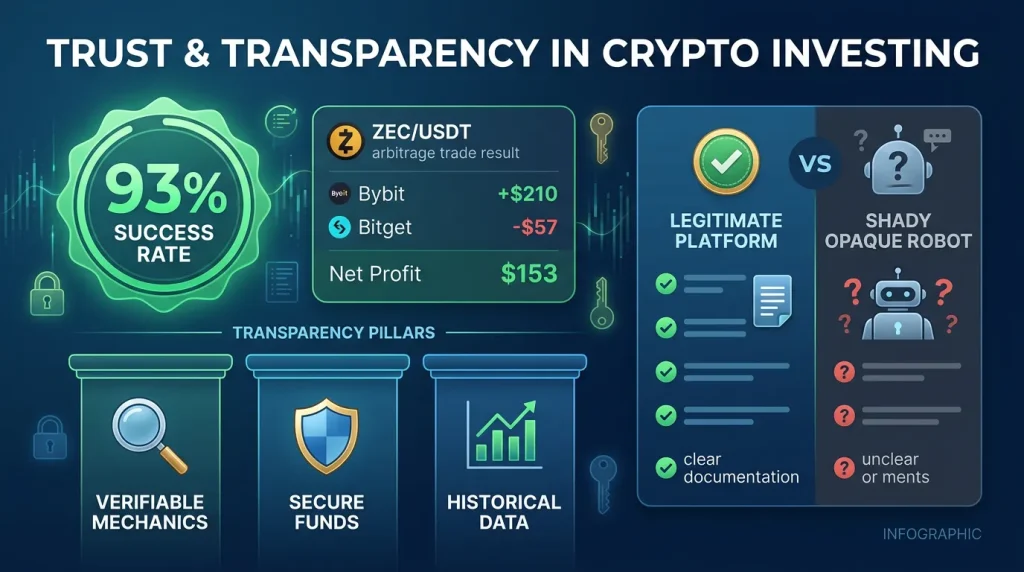
During a sharp decorrelation in the ZEC/USDT pair, the spread between Bybit and Bitget reached 7%. The system automatically opened a long on Bybit and a short on Bitget. When prices converged on both exchanges, positions were closed. The result:
- Bybit: +$210
- Bitget: −$57
- Net profit on the trade: $153
No one “predicted” the direction of ZEC — the strategy was entirely market-neutral.
Platform statistics: 93% of arbitrage trades close with a positive mathematical expectation. This is achieved through strict entry filtering (minimum 3% spread) and dynamic position management.
For context: professional arbitrage funds on Wall Street and in Asia target 30–60% annually — and that’s considered an excellent result with minimal correlation to market risk. PrimeARB AI brings an equivalent strategy to retail investors in an accessible format.
How to Get Started with PrimeARB AI: Concrete Steps
If you’ve read this far and want to try it out — here is a transparent plan with no “secret steps”:
Step 1 — Registration. Go to the official PrimeARB AI website, click “Get Started,” and fill out the form with your email and password. Time required: 3–5 minutes. Enable two-factor authentication immediately — it’s basic security hygiene.
Step 2 — Verification (KYC). Upload an identity document (passport or national ID) and take a selfie holding it. The process takes 10–15 minutes; review is completed within a few hours to 1–2 business days. This is a standard international AML/KYC requirement.
Step 3 — Deposit. Fund your account with cryptocurrency (USDT, BTC, ETH) or bank transfer. Minimum: $500–1,000 to start; recommended: $3,000–5,000.
Step 4 — Choose your mode. For your first experience, select the conservative mode: 30–50% of capital deployed, expected return 3–8% per month. After 2–4 weeks, once you’ve observed how the system behaves, you can adjust parameters.
Step 5 — Launch and monitor. Click “Activate Trading.” The first trade typically opens within 24–48 hours — the system waits for a qualifying spread. Your personal dashboard shows all open positions, current spreads, P&L per trade, and the full history of closed operations in real time.
The Bottom Line: Transparency Is the Best Indicator of Legitimacy
When evaluating any financial service — whether PrimeARB AI, DHL Bitcoin Era, or any other “trading robot” — ask yourself three questions:
- Can the platform explain in plain language where the profit actually comes from? 2. Are my funds held in my own accounts, or am I handing money over to someone to “manage”? 3. Is there real, verifiable statistics and trade history — or just Telegram screenshots?
Futures arbitrage is not magic. It’s a mathematical strategy built on real market inefficiencies that will persist for as long as multiple crypto exchanges and price volatility exist. PrimeARB AI automates this strategy, making it accessible to those who lack the time, technical expertise, and nerves required for manual trading.
Start small. Choose the conservative mode. Observe the system’s logic at work. And make decisions based on data — not advertising promises.
This article is for educational purposes only and does not constitute financial advice. Trading cryptocurrency futures involves risk. Past performance does not guarantee future results. Only invest funds whose potential loss would not critically impact your financial situation.
Information about the author

As head of the PrimeARB AI platform, Nathan applies his many years of experience in financial markets and technology to create an innovative AI system for futures arbitrage. His vision is to make professional trading strategies accessible to a wide range of investors through automation and artificial intelligence.
Nathan Michaud is a recognized professional trader with over 20 years of experience trading on the NYSE and Nasdaq exchanges in the United States. Starting his trading career in 2003 as a student at the University of New Hampshire – Whittemore School of Business and Economics, Nathan quickly turned his passion for financial markets into a successful career.
