In March 2026, the cryptocurrency market experienced one of the most dramatic crashes in its history. Bitcoin plummeted from $68,000 to $41,000 in 72 hours—a 40% loss. Millions of traders worldwide watched their portfolios melt before their eyes. Telegram channels exploded with panic, exchanges temporarily suspended withdrawals due to overload, and news feeds were filled with headlines about “the end of the crypto era.”
But amidst this chaos, something unusual happened: users of the PrimeARB AI automated arbitrage system not only didn’t lose money—many showed record quarterly returns. How is this possible? Why, when everyone was selling at a loss, were robots calmly earning? Let’s explore how futures arbitrage works in moments when traditional strategies collapse.

The Problem: When Regular Trading Becomes a Lottery
Imagine a typical cryptocurrency investor—let’s call him Andrew. In January 2026, he bought 0.5 BTC at $65,000, investing his savings of $32,500. By early March, his portfolio was worth $34,000—a small gain, but Andrew was satisfied and held his position, expecting growth to $80,000 that all analysts were predicting.
And then the crash began.
March 14, 03:47 UTC: A Chinese exchange publishes an unexpected report on massive USDT withdrawals. Rumors about stablecoin backing issues spread within minutes.
March 14, 08:15 UTC: Bitcoin drops to $58,000. Andrew wakes up, sees notifications, and freezes—should he sell at a loss or hold longer?
March 15, 14:30 UTC: The SEC announces an investigation into three major crypto exchanges. Bitcoin—$49,000. Andrew panics and sells at $48,500, locking in a 25% loss.
March 16, 21:00 UTC: The market finds a bottom at $41,000. By this point, Andrew is out of the market, having lost $8,000 and vowing never to touch cryptocurrencies again.
This story repeated for millions of people. The main problem with regular trading—you’re always betting on market direction. And when the bet doesn’t pay off, the only choice is to lose money or lose more money.
But there are people who earned during these same 72 hours. How?

Educational Block: What Is Market Neutrality and Why It Matters
To understand how you can earn during a crash, you need to grasp one key concept: market-neutral strategies.
The Difference Between Speculation and Arbitrage
Speculation is when you predict the future:
- “Bitcoin will rise” → you buy
- “Ethereum will fall” → you sell
Your profit depends entirely on whether you guessed the direction correctly.
Futures arbitrage is when you earn from market inefficiency, not its direction:
- You simultaneously open a long position (LONG) on one exchange and a short position (SHORT) on another
- You don’t care where the price goes—up or down
- You earn from the convergence of price differences between exchanges
Why Do Spreads Increase During Crises?
In calm times, Bitcoin trades at roughly the same price across all exchanges—say, $65,000 ±$50. Spreads are small, arbitrage opportunities are scarce.
But when panic begins, this happens:
- Asynchronous exchange reactions: Some exchanges see selling waves earlier than others due to regional differences and liquidity
- Mass liquidations of margin positions: On one exchange, thousands of stop-losses trigger, crashing the price by 8%, while on another—only 4%
- Technical overloads: Some exchanges slow down or temporarily halt trading, creating huge gaps
- Emotional selling: Panicking people sell “at market” on the nearest exchange where they have an account, without comparing prices
Result: On a normal day, the spread between Binance and Bybit might be 0.5%. During the March 2026 crash, it reached 7-12%.
Concrete Example with Real Numbers
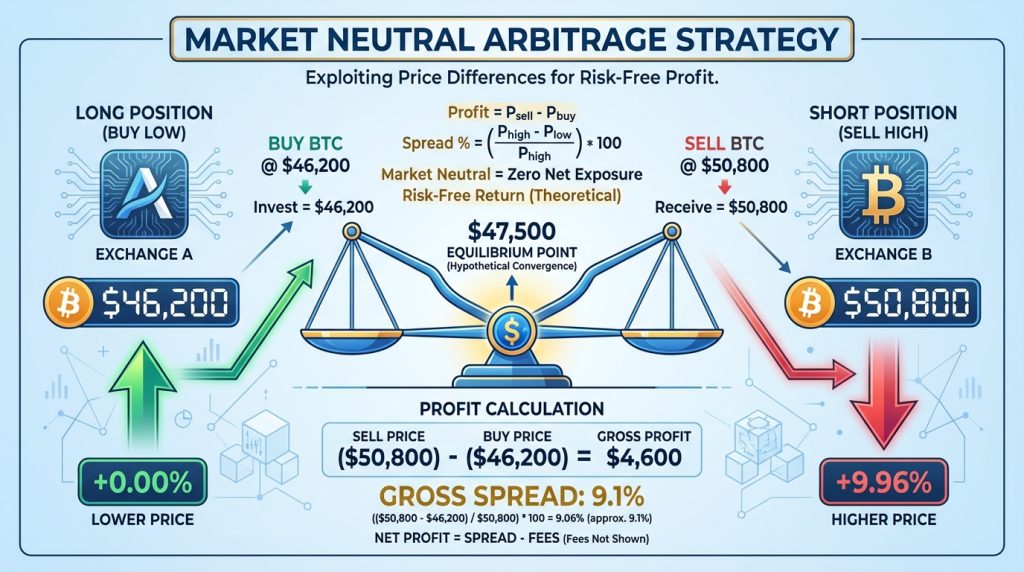
March 15, 2026, 18:42 UTC:
- Bybit: BTC/USDT futures = $46,200
- Gate.io: BTC/USDT futures = $50,800
- Spread: 9.1%
The PrimeARB AI system sees this opportunity and in 0.3 seconds:
- Opens LONG (buys) on Bybit at $46,200 for $5,000
- Opens SHORT (sells) on Gate.io at $50,800 for $5,000
What happens next?
Six hours later, the panic subsides, and prices equalize to $47,500 on both exchanges.
Profit calculation:
- Bybit (LONG): Bought at $46,200, sold at $47,500 = +$1,300 (+2.81%)
- Gate.io (SHORT): Sold at $50,800, bought at $47,500 = +$3,300 (+6.50%)
- Total: $1,300 + $3,300 = $4,600 on $10,000 (considering both positions)
- Fees: 0.05% × 4 operations = 0.20% = $20
- Net profit: $4,580 or 45.8% in 6 hours
Key point: The system didn’t care at all that Bitcoin fell from $65,000 to $47,500. It earned from the difference between exchanges that arose due to chaos.
While Andrew lost 25% of his capital holding a regular long position, the arbitrage robot earned 45.8% in one night.
The Solution: How PrimeARB AI Turns Chaos Into Opportunities
Now that you understand the principle, let’s see exactly how the system worked during the March 2026 crash.
The Mechanism: 5 Stages of an Automatic Trade
Stage 1: High-Speed Scanning
The PrimeARB AI system monitors futures prices on 8 exchanges simultaneously (Binance, Bybit, MEXC, Gate.io, Bitget, BingX, OKX, WEEX) through dedicated servers with minimal latency.
During the crash, the screener operated in enhanced mode:
- Scanning: Every 0.5 seconds
- Analysis: Over 200 trading pairs × 8 exchanges = 1,600 combinations
- Processing: Calculating spreads, liquidity, historical convergence data
Stage 2: Opportunity Filtering
Not every spread is a good opportunity. The system selects trades based on parameters:
✅ Spread ≥ 3% (minimum threshold to cover fees and target profit)
✅ Sufficient liquidity (checking order book depth—no point entering if you can’t execute without slippage)
✅ Historical convergence statistics (the system “knows” that BTC/USDT usually converges in 2-8 hours, while exotic altcoins can diverge for weeks)
✅ Low volume volatility (if the exchange has abnormally low trading, it’s a warning sign)
During the crash, the system rejected 87% of potential signals, selecting only the safest ones.
Stage 3: Instant Execution via API
Once a suitable opportunity is found, the system acts automatically through exchange APIs:
- Submitting orders to both exchanges simultaneously (critical—if positions open with delay, the spread may change)
- Using TAKER orders for guaranteed execution (speed is more important than saving 0.02%)
- Setting stop-losses immediately on exchanges (protection in case of technical failures or further divergence)
Execution speed: Average time from spread detection to position opening—0.3-0.8 seconds.
For comparison: a human trading manually would spend at least 30-60 seconds on analysis, logging into two exchanges, calculating position size, placing orders. By that time, the spread would have already closed.
Stage 4: Monitoring and Position Protection
After opening, the system doesn’t “go to sleep”—it continuously tracks:
- Spread dynamics: Is the difference narrowing or widening?
- Exchange status: Are there technical issues, trading halts, anomalies?
- Margin requirements: Are there enough free funds in case of temporary drawdown?
- Time in position: If a trade has been open for more than 72 hours without convergence, the forced closing algorithm activates
Multi-level protection:
🛡️ Stop-loss on exchange: If the spread increased from 3% to 7% (anomaly), the position closes automatically with limited loss
🛡️ Liquidity monitoring: If trading volume drops sharply on one exchange, the system may close the position early
🛡️ Capital reservation: Always keeps 30-50% of deposit free to cover margin requirements
Stage 5: Automatic Closing on Convergence
When the spread narrows to the target level (usually 0.3-0.5%), the system closes both positions simultaneously:
- Sells LONG on the first exchange
- Closes SHORT on the second exchange
- Locks in profit
Typical sequence during March 2026:
- 00:00-06:00 UTC: Maximum spreads 7-12%, 12 positions opened
- 06:00-12:00 UTC: Market begins stabilizing, spreads 4-6%
- 12:00-18:00 UTC: First positions close with 3-5% profit
- 18:00-24:00 UTC: 10 out of 12 positions closed, 2 held longer
Average trade duration during crisis: 4-14 hours (in calm times—1-3 days).
Unique Advantage: Unified Deposit and Automatic Sub-accounts

One of the main problems with independent arbitrage—logistical nightmare:
❌ Need to register on 8 exchanges
❌ Pass KYC on each
❌ Manually distribute capital between exchanges
❌ Constantly transfer funds where opportunities appear
❌ Monitor balances on all accounts
PrimeARB AI solves this elegantly:
✅ You deposit once into a unified system account
✅ The system automatically creates sub-accounts on exchanges through the company’s internal APIs
✅ Capital is distributed dynamically where opportunities currently exist
✅ You manage everything through one interface
During the March crash, this was critically important: opportunities appeared on Bybit, then Gate.io, then MEXC. The system automatically redistributed capital between exchanges 47 times in 72 hours to catch maximum spreads. Manually, this would have been impossible.
Security: Your Money Stays With You
The main question from beginners: “What if they cheat and steal my money?”
Here’s how security works:
🔐 Funds are stored on exchanges, not with PrimeARB AI Your capital remains in your exchange sub-accounts (Binance, Bybit, etc.). The system has no withdrawal access—only trading through API keys with limited permissions.
🔐 API keys without withdrawal rights During setup, you create API keys with rights only for:
- Viewing balance
- Placing/closing orders
- Reading trade history
The “Withdrawal” option is always disabled. Even if someone gains system access, stealing money is physically impossible.
🔐 KYC verification PrimeARB AI requires KYC (identity verification), which complies with international AML (Anti-Money Laundering) standards and increases trust.
🔐 Stop-losses on exchanges Loss protection doesn’t depend on system operation—stop orders are placed directly on exchanges through their built-in mechanisms.
Even if:
- Your internet disconnects
- PrimeARB AI servers are unavailable
- A system failure occurs
…the exchange will automatically close the position when the critical loss level is reached (usually 1-2% per trade).
Social Proof: Statistics and Real Cases
Numbers from March 2026
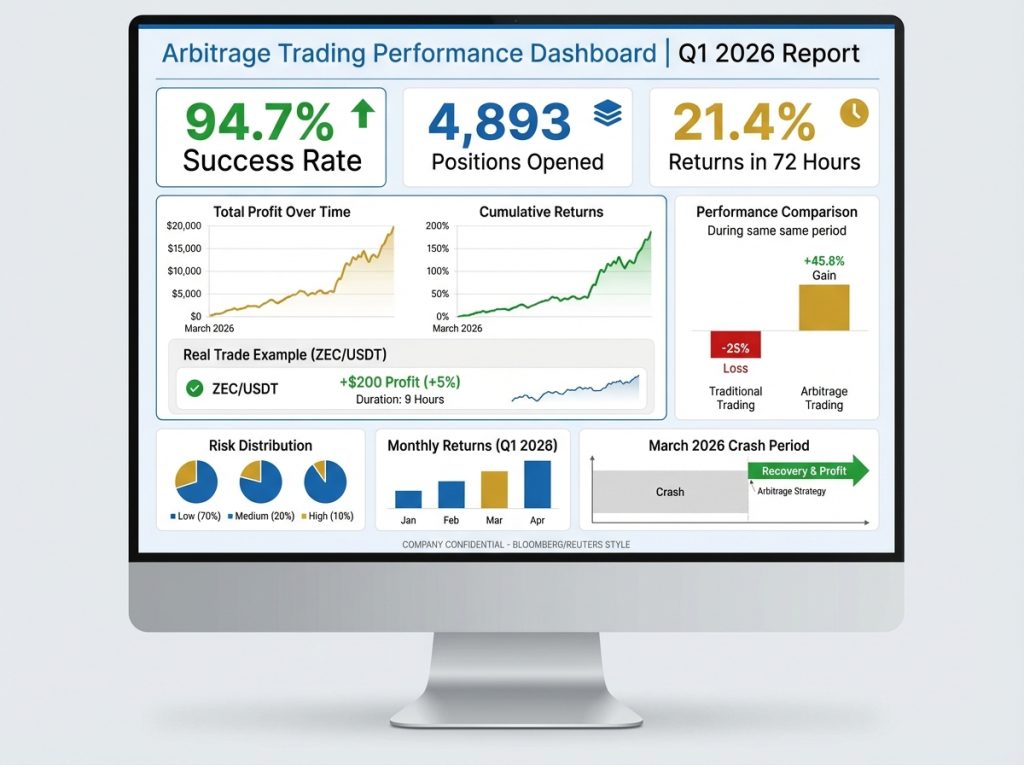
PrimeARB AI published aggregated system performance statistics during the crash (data anonymized):
📊 Active users: 1,247
📊 Arbitrage positions opened: 4,893
📊 Trade success rate: 94.7% (above the usual 93%)
📊 Average profit per trade: 3.8%
📊 Average returns in 72 hours: 21.4% (versus usual 2-3% for the same period)
Why did success rate increase? During the crisis, spreads were so large that even if prices diverged further by 1-2%, stop-losses didn’t trigger—the initial “safety margin” of 7-12% provided a huge cushion.
Case #1: ZEC/USDT Pair (Zcash)
Date: March 15, 2026, 14:20 UTC
Exchanges: Bybit (LONG) and Bitget (SHORT)
Initial spread: 7.2%
Details:
- Bybit: Entry price $28.40 (LONG)
- Bitget: Entry price $30.45 (SHORT)
- Position size: $2,000 on each exchange ($4,000 total)
Convergence dynamics:
- T+2 hours: Spread 5.1%
- T+6 hours: Spread 2.3%
- T+9 hours: Spread 0.4%—positions closed
Result:
- Bybit: +$74 (bought at $28.40, sold at $29.11)
- Bitget: +$134 (sold at $30.45, bought at $29.11)
- Net profit: $208 minus fees $8 = $200 (+5% in 9 hours)
Case #2: Why Even “Losing” Trades Aren’t Scary
Not all trades were perfect. Here’s an example when things didn’t go as planned:
Date: March 16, 2026, 03:15 UTC
Exchanges: MEXC (LONG) and OKX (SHORT)
Pair: ETH/USDT
Initial spread: 4.1%
What happened: Four hours after opening, MEXC exchange announced technical maintenance for 2 hours. The spread didn’t narrow but instead widened to 5.8%. Stop-loss triggered.
Result:
- MEXC (LONG): -$38
- OKX (SHORT): +$21
- Loss: -$17 on $3,000 position (-0.57%)
But: On the same day, the system closed 5 other positions with profits of 2.5-4.2%. Total daily result: +$428.
This is positive mathematical expectation—even when one trade out of ten is unprofitable, the other nine cover losses with a margin.
Comparison with Professional Funds
For context: major arbitrage hedge funds (such as Jane Street Capital, Jump Trading) target 30-60% annual returns on arbitrage strategies.
PrimeARB AI offers comparable returns, but with an entry threshold of $3,000-5,000 instead of a $1,000,000 minimum for institutional funds.
Addressing Objections: Honest Answers to Uncomfortable Questions
“This sounds too good. What’s the catch?”
There’s no catch, but there are realistic expectations:
✅ This is not a get-rich-quick scheme. March 2026 was an extreme month—such returns (20%+ in 3 days) happen 2-3 times a year. In calm periods, expect 3-8% per month.
✅ There are losing trades. A 93-95% success rate means 5-7% of trades close at a loss. But the overall result is positive thanks to risk management.
✅ Capital is required. With $500 you can technically start, but comfortable operation starts at $3,000. This isn’t “invest $100 and become a millionaire in a month.”
“What if both exchanges crash simultaneously or freeze accounts?”
Trading halt risk: That’s exactly why the system trades on 8 exchanges, not two. The probability of simultaneous technical failure of all exchanges is extremely low.
Protection:
- Stop-losses are placed on the exchanges themselves
- You can always log in to the exchange’s web interface and close positions manually
- Maximum risk per trade—1% of deposit (configurable)
Account blocking: Since sub-accounts are created through the company’s legitimate APIs and KYC is completed, the blocking risk is minimal. Trading complies with exchange rules.
“How much time do I need to dedicate to system control?”
Minimum mode: 15-20 minutes per day
- Check open positions in the morning
- Review results in the evening
Recommended mode: 30-40 minutes per day
- Analyze weekly statistics
- Adjust parameters (if needed)
- Read news about exchanges (scheduled maintenance, etc.)
Critical: The system is 95% automated. You don’t need to sit in front of a screen 24/7 like with regular trading.
“Is this safer than just holding Bitcoin?”
Different strategies, different risks:
Holding (HODL):
- Risk: 40-80% drawdown during bear markets
- Potential: 300-500% over several years
- Suitable for: Long-term investors with iron nerves
PrimeARB AI Arbitrage:
- Risk: 5-10% drawdown in worst periods
- Potential: 50-150% annually with reinvestment
- Suitable for: Those who want stable income without emotional rollercoasters
Golden strategy: Many users combine—50% of capital held in BTC/ETH long-term, 50% used in arbitrage for regular income generation.
“What if cryptocurrencies are banned?”
Regulations are tightening, but arbitrage is legal in all jurisdictions. This isn’t a tax evasion scheme or fraud—it’s a regular trading strategy used by institutional funds.
Moreover: Regulatory tightening often increases volatility, meaning more spreads and opportunities appear.
Call to Action: Where to Start
If the idea of earning from market inefficiency rather than guessing its direction appeals to you—here are concrete steps:
Step 1: Education (One Week)
Before investing money:
- Study basic concepts of futures and arbitrage (free materials on PrimeARB AI website)
- Watch the system demo version
- Read FAQ and user cases
Don’t rush. Better to spend a week understanding than jump in with money and panic at the first drawdown.
Step 2: Registration and Verification (2-3 Days)
- Register on the PrimeARB AI platform
- Complete KYC (upload passport, selfie—standard procedure)
- Wait for confirmation (usually 24-48 hours)
Step 3: Deposit
Recommendation for beginners:
- Start: $3,000-5,000 (optimal balance between efficiency and risk)
- Method: USDT, BTC, or ETH (faster and cheaper than bank transfer)
Don’t deposit money you can’t afford to lose. This isn’t guaranteed income but an investment with risk.
Step 4: Parameter Setup (First Day)
The system will offer mode selection:
For beginners: Conservative (30-50% of deposit working)
- Fewer simultaneous positions
- Stricter spread selection criteria
- Expected returns: 3-8% per month
- Psychological comfort: maximum
Recommendation: Start with conservative mode. After a month, when you see real results and understand the logic, you can switch to balanced (8-15% per month).
Step 5: First Trade (24-48 Hours)
After activation, the system automatically begins scanning. Usually, the first opportunity appears within 24 hours.
What you’ll see:
- Notification: “New arbitrage position opened”
- Details: Pair (e.g., BTC/USDT), exchanges, spread, position size
- Monitoring: Current P&L (profit & loss) in real-time
Step 6: Analysis and Adjustment (First Month)
During the first 4 weeks:
- Track results of each trade
- Ask questions in support (usually respond within 2-4 hours)
- Read weekly system reports on market conditions
- Adjust parameters if needed
Main thing: Don’t panic at the first losing trade. Evaluate results over a month, not a day.
When “Black Swans” Become Opportunities
March 2026 will go down in crypto history as one of the most brutal crashes. But for those who used market-neutral strategies, it was a month of record returns.
Key lesson: You don’t need to predict the future to earn in financial markets. It’s enough to exploit their inefficiency—and in chaos, inefficiency is at its maximum.
PrimeARB AI isn’t a magic “get rich” button. It’s a professional tool for systematic earning with controlled risk that was previously available only to institutional funds with million-dollar budgets.
Now it’s accessible to private investors with capital from $3,000.
The next crisis is inevitable—maybe in a month, maybe in a year. The question isn’t whether it will happen, but how you’ll meet it:
- With panic, selling at a loss like Andrew?
- Or with calm, watching the robot earn from volatility?
The choice is yours.
Start with education: Visit the official PrimeARB AI website, explore the system demo version, and ask questions in the support chat. The first step is always education, not deposit.
Disclaimer: This article is educational in nature. Cryptocurrency trading involves risk. Past results do not guarantee future returns. Invest only funds you can afford to lose.
Information about the author

As head of the PrimeARB AI platform, Nathan applies his many years of experience in financial markets and technology to create an innovative AI system for futures arbitrage. His vision is to make professional trading strategies accessible to a wide range of investors through automation and artificial intelligence.
Nathan Michaud is a recognized professional trader with over 20 years of experience trading on the NYSE and Nasdaq exchanges in the United States. Starting his trading career in 2003 as a student at the University of New Hampshire – Whittemore School of Business and Economics, Nathan quickly turned his passion for financial markets into a successful career.
