Why experienced investors are switching from trading to arbitrage — and how automation turns market chaos into stable income
When Volatility is Not a Problem, But an Opportunity
January 2026 will be remembered by many crypto investors for its panic: Bitcoin plummeted 18% in 72 hours, altcoins dropped 30-40%. Telegram channels were flooded with messages about liquidations and zeroed deposits. Thousands of traders closed their terminals, vowing never to return to cryptocurrencies.
But there was one group of investors who calmly locked in +4.7% profit for the week during this time. Without stress, without 24/7 chart monitoring, without guessing “the bottom.” Their secret? They weren’t trying to predict market direction — they were earning from its inefficiency.
We’re talking about futures arbitrage — a strategy that professional funds have used for decades in traditional markets, and now it’s accessible to retail investors through the automated PrimeARB AI platform.

The Problem: Why 90% of Retail Traders Lose Money
If you’ve ever tried trading cryptocurrency, you know this pain:
Emotional burnout. You wake up at night to check if the market has crashed. Every red candle triggers panic, every green one — fear of missing profits. This isn’t investing — it’s a casino with your nerves as the stake.
Playing against professionals. On the other side of the screen are hedge fund algorithms with millisecond data access, market makers with infinite liquidity, insiders with information before everyone else. You’re guessing market direction? They already know it.
Volatility kills deposits. Bitcoin rose 15%? Great! But if you bought an altcoin that dropped 20% during the same period, your “diversification” didn’t save you. Directional trading is always a bet where the probability of losing exceeds 50% after accounting for fees and spreads.
Technical errors. Forgot to set a stop-loss? Didn’t close a position before sleep? Internet disconnected during a sharp movement? In manual trading, one mistake can wipe out weeks of profits.
Statistically, about 90% of retail traders in cryptocurrency markets lose money within the first year. Not because they’re stupid — because they’re playing a game with negative mathematical expectation.
What if you don’t play this game at all? What if you can earn not from market direction, but from its imperfection?

What is Futures Arbitrage — Explained Simply
Imagine you walked into two supermarkets on the same street. In the first, apples cost $3 per kilogram, in the second — $5. You buy in the first and resell in the second. The $2 difference is your profit, and you don’t care if apples get more expensive tomorrow or cheaper. You earned from the price difference between selling points.
Futures arbitrage works on the same principle, except instead of physically moving goods, you open opposite positions on different exchanges:
How It Works Technically:
Step 1: Detecting Discrepancy The PrimeARB AI screener monitors futures prices across 8 cryptocurrency exchanges (Binance, Bybit, MEXC, Gate.io, Bitget, BingX, OKX, WEEX). Let’s say Bitcoin is trading:
- On Binance: $98,000
- On Bybit: $101,000
The difference is 3%, or $3,000.
Step 2: Simultaneous Position Opening The system automatically:
- Buys (LONG) on Binance at $98,000
- Sells (SHORT) on Bybit at $101,000
You’ve locked in the spread of $3,000 between exchanges.
Step 3: Waiting for Price Convergence After several hours (or days), prices equalize to, say, $99,500 on both exchanges. The market itself eliminates inefficiency — that’s how all markets work.
Step 4: Closing Positions and Taking Profit
- On Binance: You sell at $99,500 (bought at $98,000) → profit +$1,500
- On Bybit: You buy back at $99,500 (sold at $101,000) → profit +$1,500
Total: $3,000 profit minus exchange fees (~0.20% of turnover) = net profit around 2.8%.
Key Difference from Speculation:
You don’t care if Bitcoin went up or down. Even if the price crashes to $50,000 on both exchanges:
- On Binance you’d lose $48,000 (bought at $98k, price fell to $50k)
- On Bybit you’d earn $51,000 (sold at $101k, bought back at $50k)
The difference between exchanges will still collapse, and you’ll collect your 2.8%. This is called a market-neutral strategy — it earns in any market direction.
Why Do Such Differences Arise?
The cryptocurrency market is fragmented: hundreds of exchanges operate independently, with different liquidity, different users, in different regions. When regulatory news breaks at 3 AM European time, Asian exchanges react faster. When a large player places a big order on one exchange, the price shifts there, but not on others.
Professional arbitrage funds have been earning from such discrepancies in traditional markets (stocks, currencies, commodities) since the 1990s. In cryptocurrencies, due to the market’s youth and high volatility, these opportunities arise much more frequently.
The Solution: How PrimeARB AI Automates Earning from Market Inefficiency
Theoretically, anyone can trade arbitrage manually. Practically — it’s technically complex, requires enormous time, and is prone to errors. You need to:
- Register on 8 exchanges (KYC, verification, 2FA setup)
- Create and configure API keys with correct permissions
- Constantly monitor prices manually or write your own bot
- Manually distribute capital between exchanges
- Execute orders lightning-fast (10-second delay = missed profit)
- Calculate position sizes accounting for margin requirements
- Track dozens of open positions simultaneously
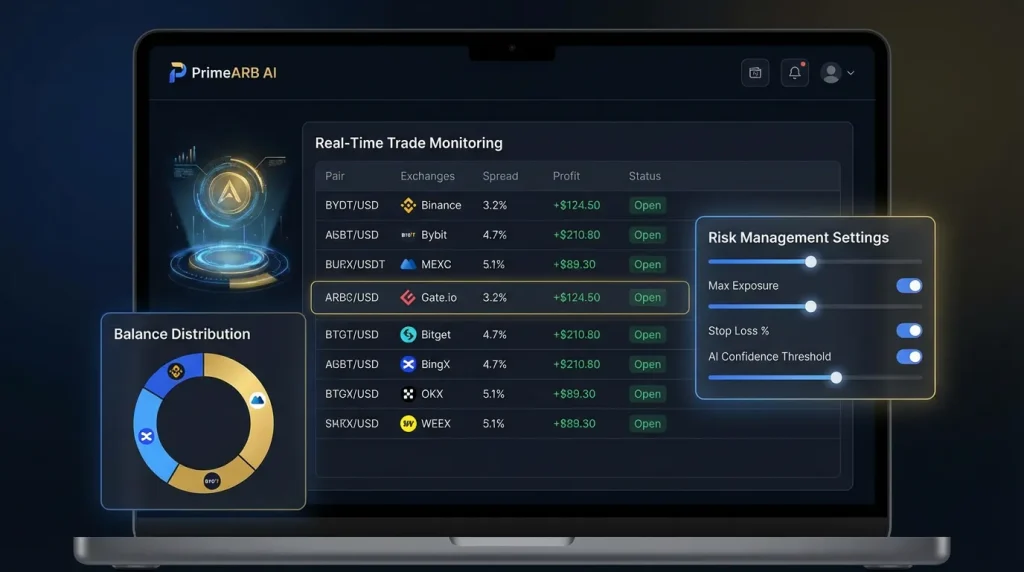
PrimeARB AI solves all these problems automatically:
1. Single Deposit — Automatic Sub-Account Creation
You don’t register on exchanges yourself. After KYC verification in the PrimeARB AI system, the platform automatically creates sub-accounts on partner exchanges through the company’s internal APIs. You deposit funds once into a unified account, and the system distributes capital between exchanges optimally.
It’s like trust management, but with full control: your funds remain on your exchange sub-accounts (not on PrimeARB accounts), you see the balance in real-time, API keys are configured without withdrawal permissions.
2. High-Speed 24/7 Screener
While you sleep, the algorithm every second:
- Receives price data from 8 exchanges
- Calculates spreads across hundreds of trading pairs
- Filters opportunities by criteria: minimum 3% spread, sufficient liquidity, historically stable convergence
- Assesses risks: asset volatility, order book depth, past convergence time
Only 2-3% of signals pass all filters. The system doesn’t open positions “just to trade” — it waits for mathematically advantageous opportunities.
3. Instant API Execution
When a signal appears, the system simultaneously places orders on both exchanges via API in less than 100 milliseconds. Trading occurs from dedicated servers with minimal ping to exchanges.
This is critical: manual placement would take 20-30 seconds, during which the spread could collapse. Automation isn’t a luxury, it’s a necessity in arbitrage.
4. Automatic Closing and Stop-Loss Protection
The system continuously monitors open positions:
- When the spread narrows to 0.3-0.5% (goal achieved), positions close automatically
- If the spread widens instead of narrowing (anomaly), a stop-loss triggers, limiting loss to 1-2%
- Stop-losses are set on the exchanges themselves, not in the program — even if internet disconnects, the exchange will close the position at critical loss level
Statistically, 93% of trades close with positive results. The remaining 7% are trades where the spread didn’t fully collapse or stop-loss triggered. But thanks to positive mathematical expectation, the overall result of a series of trades is consistently profitable.
5. Flexible Capital Management Modes
You choose what portion of deposit actively works:
- Conservative (30-50% working): 3-8% monthly, maximum safety, large margin reserve
- Balanced (60-70% working): 8-15% monthly, optimal balance for most users
- Aggressive (80-90% working): 15-25% monthly, maximum returns, requires experience
Beginners are recommended to start with conservative mode and observe the system’s work for 2-4 weeks before increasing activity.
Real Case: Week of January 12-19, 2026

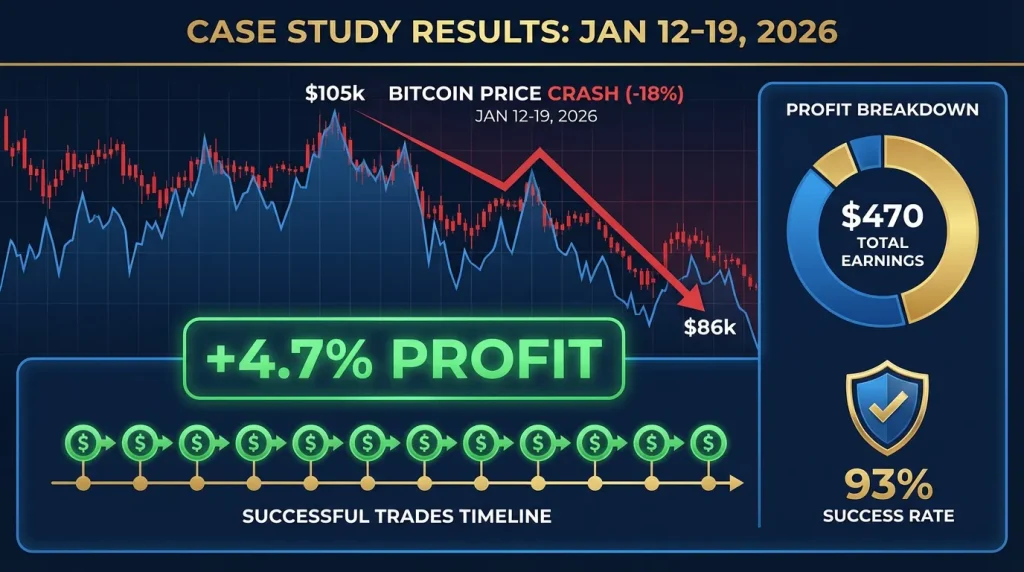
Let’s examine a specific example of how PrimeARB AI earned 4.7% in a week on a $10,000 deposit during market chaos.
Market Context:
From January 12-15, Bitcoin fell from $105,000 to $86,000 (-18%). Altcoins crashed even harder: Ethereum -22%, Solana -35%, many smaller tokens lost 50-60% capitalization. The cause — news about stricter crypto exchange regulation in the US and mass leverage liquidations.
For traders, this was catastrophic. For arbitrage — golden time: high volatility creates more discrepancies between exchanges.
System Operating Parameters:
- Deposit: $10,000 in USDT
- Mode: Balanced (65% capital working)
- Exchanges: All 8 (Binance, Bybit, MEXC, Gate.io, Bitget, BingX, OKX, WEEX)
- Traded pairs: BTC/USDT, ETH/USDT, SOL/USDT, XRP/USDT, DOGE/USDT
Trade Chronology (selected):
January 13, 02:17 UTC — Trade #1: ZEC/USDT
- Spread: 7.2% (Bybit $47.20 vs Bitget $50.60)
- Position size: $1,500
- Opening: LONG Bybit $47.20, SHORT Bitget $50.60
- Closing after 8 hours: Both positions at $48.90
- Result: +$108 after fees (7.2% profit on $1,500)
This is a classic example: post-news volatility caused sharp price divergence on low-liquidity ZEC (Zcash) pair. The system instantly caught the signal, opened positions, waited for convergence.
January 14, 14:35 UTC — Trade #2: ETH/USDT
- Spread: 4.1% (MEXC $2,420 vs OKX $2,520)
- Position size: $2,000
- Opening: LONG MEXC, SHORT OKX
- Closing after 18 hours: Both at $2,470
- Result: +$82 after fees (4.1% on $2,000)
Ethereum during the crash showed different fall speeds on exchanges. On MEXC (smaller exchange) the price fell lower, creating an arbitrage opportunity.
January 16, 09:22 UTC — Trade #3: BTC/USDT
- Spread: 3.5% (Gate.io $88,200 vs Binance $91,300)
- Position size: $2,500
- Opening: LONG Gate.io, SHORT Binance
- Closing after 26 hours: Both at $89,800
- Result: +$87.5 after fees
This is an example of a long position: convergence took over a day, but final profit was secured.
January 18, 21:50 UTC — Trade #4 (unprofitable): SOL/USDT
- Spread: 3.8% (Bybit $140 vs BingX $145.30)
- Position size: $1,200
- Opening: LONG Bybit, SHORT BingX
- Problem: Spread widened to 5.1% instead of narrowing (BingX experienced technical issues)
- Stop-loss triggered after 4 hours
- Result: -$14 (1.2% loss on $1,200)
Important to show failures too: not every trade is profitable. But stop-loss limited the loss, which is covered by other trades’ profits.
Weekly Summary Statistics:
- Total trades opened: 12
- Successful closings: 11 (91.7%)
- Unprofitable: 1
- Total profit: $470 (including $14 loss compensated)
- Return on $10,000 deposit: +4.7%
- Average position duration: 16 hours
- Maximum drawdown: -0.14% (brief, quickly compensated)
For comparison: a trader who bought Bitcoin at the week’s start would have lost 18%. Someone holding Solana — 35%. PrimeARB AI arbitrage showed +4.7% during the same period because it doesn’t depend on market direction.
Proof: Why This Isn’t Coincidence
Mathematics of Positive Expectation
Take a conservative calculation:
- Average entry spread: 3.5%
- Exchange fees (taker 0.05% × 4 operations): 0.20%
- Target profit after convergence: 2.8-3.0%
- Successful convergence probability: 90-93%
If out of 100 trades, 93 bring +2.8% and 7 give -1.2% (stop-loss):
- Profit: 93 × 2.8% = +260.4%
- Losses: 7 × 1.2% = -8.4%
- Total: +252% on a series of 100 trades
This is a simplified model, but it illustrates why arbitrage works systematically: each trade has statistical advantage, and a series of trades smooths random fluctuations.
Comparison with Professional Funds
Hedge funds specializing in arbitrage (e.g., Citadel, Jane Street) target 30-60% annually in traditional markets with much lower volatility. Cryptocurrencies, thanks to market youth, provide more opportunities — hence the potential of 50-150% annually for retail investors through PrimeARB AI.
Historical Data
According to PrimeARB AI internal statistics (data from technical_specs.md):
- 93% success rate of trades in 2025-2026
- Average returns of 8-12% monthly during moderate volatility periods
- 15-25% monthly during active periods (regulatory news, ETF launches, major BTC/ETH movements)
Past results don’t guarantee future ones, but they confirm strategy sustainability.
Dispelling Doubts: Honest Answers to Objections
“This isn’t a get-rich-quick scheme?”
Correct, it’s not a scheme. Arbitrage is systematic earning with controlled risk, not a way to “double capital in a week.” Realistic returns are measured in percentage points monthly, not hundreds of percent.
Analogy: it’s more like opening a successful coffee shop franchise (predictable 15-20% annual income) than buying a lottery ticket (1 in a million chance to win a million).
“What if internet disconnects?”
Multi-level protection:
- Positions remain open on exchanges (not in the program)
- Stop-losses are set on the exchanges themselves — they’ll trigger even without connection
- Automatic reconnection through backup channels
- Email/Telegram notifications during problems
- You can always manually close positions through exchange web interface
In the case above, one user lost internet for 6 hours during an open position — stop-loss triggered on the exchange, loss limited to 1.1%, which was compensated by subsequent trades.
“How much capital is really needed?”
Honest answer:
- Technical minimum: $500-1000 (workable but with limitations)
- Recommended start: $3,000-5,000 (comfortable diversification across 5-6 exchanges)
- Optimal level: $10,000+ (full utilization of opportunities)
With $500 you’ll earn $15-40 monthly (3-8%), with $5,000 — $400-750, with $10,000 — $800-1,500. Absolute values grow linearly with capital.
“Is it safe? How can I trust?”
Security on three levels:
- Funds remain on exchanges: PrimeARB AI doesn’t store your money, has no withdrawal access. API keys are configured only for trading and balance reading.
- KYC verification: Mandatory procedure for international AML/KYC compliance. This protects both the company and users from fraud.
- Operation transparency: You see every trade in real-time, can verify orders on the exchanges themselves, export reports.
Risks exist (as in any investment): exchanges may experience technical problems, extreme volatility can cause abnormal spreads, regulatory changes can affect exchange operations. But arbitrage is one of the least risky ways to work with cryptocurrencies compared to directional trading.
“Why doesn’t everyone do this?”
Three reasons:
- Technical barrier: Setting up 8 exchanges, API keys, manually monitoring prices — it’s complex. PrimeARB AI removes this barrier.
- Capital: For meaningful profit, you need thousands of dollars. With $100 you’ll earn $3-8 monthly — not worth the effort.
- Lack of knowledge: 99% of beginners only heard about “buy low, sell high.” Few know about arbitrage.
Professional funds have actively used arbitrage for decades. Now this strategy is accessible to individuals through automation.
Getting Started: Step-by-Step Plan for Beginners
Step 1: Registration and Verification (1-2 days)
- Go to the official PrimeARB AI website
- Register with email (use real, not temporary)
- Complete KYC verification: upload passport photo, selfie with document
- Wait for confirmation (usually 2-24 hours)
Important: Use a strong password and enable two-factor authentication (2FA).
Step 2: Depositing (30 minutes)
- After verification, go to “Deposit” section
- Choose method: cryptocurrency (USDT recommended) or bank transfer
- Copy wallet address or requisites
- Send funds from your wallet/exchange
- Wait for blockchain confirmations (5-30 minutes for USDT-TRC20)
Tip for beginners: Start with $3,000-5,000 for comfortable operation.
Step 3: Trading Parameter Setup (10 minutes)
- System will automatically create sub-accounts on 8 exchanges
- Choose operating mode: Conservative (30-50% working) for first month
- Set parameters:
- Minimum entry spread: 3% (default)
- Risk per trade: 1% (don’t change without experience)
- Pair list: keep all top ones (BTC, ETH, SOL, etc.)
- Click “Save and Activate”
Step 4: Launch and Monitoring
System will start working automatically. First trade usually opens within 24-48 hours (depends on market volatility).
What to do next:
- Don’t panic at first drawdown — it’s normal, stop-losses protect
- Check once daily personal cabinet to understand system logic
- Don’t interfere first 2-4 weeks — let statistics accumulate
- Keep a journal: record weekly results to see progress
Step 5: Scaling (after 1-2 months)
After seeing stable results:
- Increase working capital percentage to 60-70% (balanced mode)
- Reinvest part of profits for compounding
- Consider deposit increase if results satisfy
Don’t rush: With $5,000 on conservative mode, you’ll earn $150-400 first month. This may seem small, but 50-80% annual return is a result professional managers dream about.
Arbitrage as Part of a Healthy Portfolio
Futures arbitrage through PrimeARB AI isn’t a replacement for all investments, but a smart diversification component. Professional investors distribute capital:
- 40-50% in conservative assets (bonds, index funds)
- 20-30% in growth stocks
- 10-20% in alternative investments (real estate, P2P lending)
- 10-20% in market-neutral strategies (arbitrage, hedging)
Arbitrage is a way to earn regardless of market direction. As long as multiple exchanges and cryptocurrency volatility exist, opportunities will exist. PrimeARB AI automates complex technical work, leaving you with a simple interface and predictable returns.
The case from the week of January 12-19 isn’t an anomaly, but normal system operation during high volatility. In calm periods, returns will be lower (3-8% monthly), in active ones — higher (15-25%). Average annual target of 50-100% is achievable with reinvestment and moderate market activity.
Next Step
Ready to try a strategy used by professional funds? Start with conservative mode and small capital you’re comfortable investing without emotional stress.
Registration takes 5 minutes. Verification — up to 24 hours. First trade — usually within 48 hours of activation.
Visit the official PrimeARB AI website, complete registration, and become part of investors who earn not from guessing the market, but from its mathematical patterns.
Disclaimer: Any investment carries risks. Cryptocurrency arbitrage is not a profit guarantee. Past performance doesn’t guarantee future results. Invest only funds you can afford to lose without harming your financial well-being. Before starting, it’s recommended to study all materials provided by PrimeARB AI and, if necessary, consult a financial advisor. Information in this article is educational and is not individual investment advice.
Information about the author

As head of the PrimeARB AI platform, Nathan applies his many years of experience in financial markets and technology to create an innovative AI system for futures arbitrage. His vision is to make professional trading strategies accessible to a wide range of investors through automation and artificial intelligence.
Nathan Michaud is a recognized professional trader with over 20 years of experience trading on the NYSE and Nasdaq exchanges in the United States. Starting his trading career in 2003 as a student at the University of New Hampshire – Whittemore School of Business and Economics, Nathan quickly turned his passion for financial markets into a successful career.
