Imagine this: Bitcoin right now costs $50,000 on Binance, but $51,500 on Bybit. A difference of fifteen hundred dollars for the same asset at the same time. Sounds like an error? In reality, this is a regular occurrence in the cryptocurrency market, and professional traders earn millions of dollars annually from these “gaps.” In this article, we’ll explore why such discrepancies arise, how long they exist, and most importantly—how an ordinary investor can systematically extract profit from this without market direction risk.
The Problem: A Market That Works Against You 24/7
Most people entering the world of cryptocurrencies for the first time face a harsh reality: 90% of retail traders lose money. The reasons are obvious:
Emotional burnout. The crypto market never sleeps. While you’re sleeping, Bitcoin can drop 15%, destroying your morning profits. Constant anxiety and the need to watch charts turn investing into stress.
Volatility as an enemy. You bought Ethereum at $2,000 hoping for growth to $2,500. A week later, the price is $1,600. You sell out of fear, losing 20%. A month later, ETH is back at $2,200. Guessing market direction is a game with negative mathematical expectation for most people.
Fees and slippage. Each trade eats up 0.05-0.1% in commissions. With active trading, you can give away 2-3% per month to exchanges alone. Add slippage (the difference between expected and actual execution price)—and you’re already starting in the red.
Information inequality. While you’re reading news on websites, professional funds receive signals from Bloomberg terminals and trade with millisecond latency through colocation servers next to exchanges.
But what if there’s a way to earn without guessing market direction? What if you don’t need to compete with speculators, but can profit from the market structure’s own imperfections?
Educational Block: What Are Price Discrepancies and Why Do They Exist
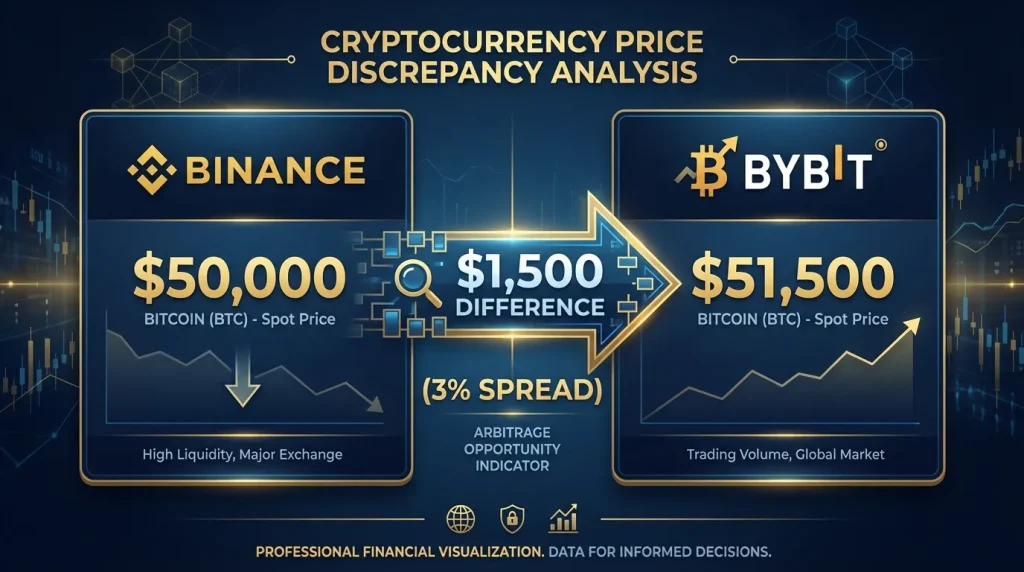
Anatomy of an Arbitrage Opportunity
A price discrepancy (or spread) is the difference in price of the same asset on different trading platforms. For example:
- Exchange A (Binance): Bitcoin futures $50,000
- Exchange B (Bybit): Bitcoin futures $51,500
- Spread: 3% ($1,500)
In theory, in an efficient market, such discrepancies should disappear instantly: traders buy where it’s cheaper and sell where it’s more expensive, equalizing prices. But the cryptocurrency market is still young and fragmented—there are dozens of independent exchanges, and price “gaps” constantly arise between them.
Five Reasons Why Discrepancies Are Inevitable
- Technical Delays and Data Update Speed
Exchanges use different technology stacks. When a sharp price movement occurs (for example, due to major news), one exchange might update quotes in 50 milliseconds, another in 200. For algorithmic traders, this is a window of opportunity.
Example: In March 2024, when the SEC approved spot Bitcoin ETFs, prices on Asian exchanges reacted 3-5 seconds faster than American ones—spreads reached 5-7%.
- Liquidity Differences
Binance is the largest exchange with billions of dollars in daily volume. Bitget or MEXC are 10-20 times smaller. On a large exchange, a $1 million order will barely move the price. On a small one, the same order will create a 2-3% spike.
Mechanism: When a large player buys on a small exchange, the price there temporarily jumps higher than on large platforms. Arbitrageurs equalize this, but while they’re doing it—a window exists.
- Regional Peculiarities and Access Restrictions
In South Korea, there has historically been a “kimchi premium”—cryptocurrencies trade 5-15% more expensive due to fiat withdrawal restrictions and high local demand. Although this premium has decreased, the principle remains: different regions = different demand = different prices.
- Withdrawal and Deposit Fees
If an exchange has high withdrawal fees or a lengthy verification process, arbitrageurs are reluctant to work there. This creates a “discount” or “premium” in price that can last for hours.
- Market Maker and Algorithm Behavior
Independent market-making bots work on each exchange, placing buy and sell orders. Their algorithms react to local conditions (volume, order book, volatility). Differences in these algorithms’ settings create temporary discrepancies.
How Long Do These Discrepancies Last?
This depends on spread size and liquidity:
- Small spreads (0.5-1%): Disappear within seconds or minutes. They’re caught by high-frequency trading bots.
- Medium spreads (2-4%): Exist from several minutes to hours. This is the main target zone for systematic arbitrage.
- Large spreads (5%+): Arise during extreme volatility (crashes, pump-and-dumps). Can last several hours but are often associated with problems on one of the exchanges (trading suspension, liquidity issues).
Statistics: According to research by Kaiko (an analytics company), in 2023-2024, the average existence time of a 3%+ spread between top exchanges was 45-90 minutes. This is long enough for an automated system to open and execute a position.
Why Don’t Discrepancies Disappear Completely?
The question everyone asks: if this is so obvious, why don’t large funds eliminate all discrepancies instantly?
The answer is simple: they do, but the market constantly creates new ones. Thousands of events happen every day—news, large fund transfers, changes in trader sentiment, technical failures. As long as multiple independent exchanges and volatility exist, arbitrage opportunities are inevitable.
Analogy: Imagine sweeping sand from a beach. While you’re sweeping one section, the wind brings sand to another. You can’t remove all the sand forever—but you can systematically profit from cleaning it up.
Solution: How Automation Allows Ordinary Investors to Compete with Professionals

Futures Arbitrage: Earning Regardless of Market Direction
Classic arbitrage requires physically moving assets between exchanges: buy Bitcoin on exchange A, transfer to exchange B, sell at a higher price. Problems? Transfer time (10-60 minutes), withdrawal fees, risk of price changes during transfer.
Futures arbitrage works more elegantly:
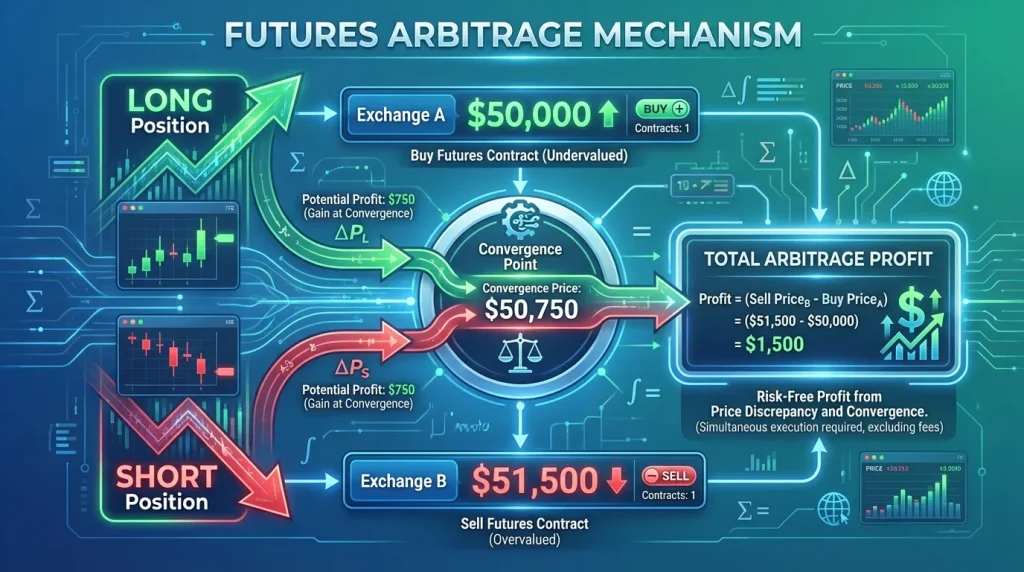
- Simultaneously open two positions:
- LONG (buy) on the exchange with the lower price (Binance, $50,000)
- SHORT (sell) on the exchange with the higher price (Bybit, $51,500)
- Wait for price convergence. After several hours or days, prices equalize to, for example, $50,750 on both exchanges.
- Close both positions:
- On Binance: bought at $50,000, sold at $50,750 = +$750
- On Bybit: sold at $51,500, bought back at $50,750 = +$750
- Total profit: $1,500 (spread) minus commissions ≈ $1,300-1,400
Key advantage: you don’t care whether Bitcoin went up or down. If the price dropped to $40,000—you lost on the long but earned on the short. If it rose to $60,000—vice versa. You earn on convergence of the difference, not on directional movement.
PrimeARB AI: A Professional Tool for Systematic Earnings
Theoretically, you could do this manually: register on 8 exchanges, constantly monitor prices, quickly place orders. The problem: by the time you register, pass verification, distribute capital, and learn to place futures orders, a month will pass. And spreads exist for seconds and minutes.
PrimeARB AI is an automated system that does all this for you:
1. Single Deposit—No Headache with Registration
The most revolutionary aspect: you don’t need to register on 8 exchanges yourself. The system automatically creates sub-accounts on partner exchanges (Binance, Bybit, MEXC, Gate.io, Bitget, BingX, OKX, WEEX), registers them for you, and links them through internal APIs.
You deposit funds into one account in the PrimeARB system. From there, capital is automatically distributed between exchanges optimally. No need to:
- Pass KYC on each exchange separately
- Manually transfer funds between accounts
- Track balances across 8 platforms
Everything is managed through a single interface.
2. High-Speed Opportunity Scanner
The system works 24/7, scanning futures contract prices on all 8 exchanges every second. The algorithm:
- Calculates spreads across hundreds of trading pairs (BTC, ETH, BNB, SOL, XRP, ADA, DOGE, and other liquid assets)
- Filters by criteria: minimum 3% spread, sufficient liquidity, order book depth
- Assesses historical convergence probability based on machine learning
- Excludes problematic pairs (delisting, trading suspension, abnormal volatility)
Speed is critical. The system uses dedicated servers with minimal ping to exchanges (colocation), ensuring latency under 50 milliseconds. A human physically cannot compete with this speed.
3. Automatic Position Opening and Closing
When a suitable opportunity is found:
- Instant execution: Orders are placed simultaneously on both exchanges via API. This minimizes the risk of “slippage”—a situation where by the time you opened a position on one exchange, the price on the second has already changed.
- Stop-loss protection: Important! Stop-loss orders are placed directly on exchanges, not in the system. This means that even if the internet connection to PrimeARB is interrupted, your positions are protected by automatic closure when reaching a critical loss level (usually -1% to -2%).
- Convergence tracking: The system monitors the spread in real-time. When prices converge to the target level (usually 0.3-0.5% residual spread), both positions close, locking in profit.
Real trade example: During strong decorrelation on the ZEC/USDT pair between Bybit and Bitget exchanges, the spread reached 7%. The system opened a long on Bybit and a short on Bitget. After time passed, prices converged to a common level, positions closed. On Bybit, the trade brought $210, on Bitget -$57. Total profit: $153 (93% of system trades close with positive results).
4. Security: Your Money Stays in Your Accounts
A critically important point for beginners: PrimeARB AI does not store your funds.
- Your cryptocurrencies remain on exchange accounts (sub-accounts created by the system)
- The system works through API keys with limited permissions: only trading and balance reading are allowed, withdrawal is prohibited
- You can revoke API keys at any time through exchange settings
- Even if the system were hypothetically hacked, an attacker couldn’t withdraw your money
This is fundamentally different from “HYIPs” and pyramids where you give money to an unknown company.
Realistic Profitability: No Deception or Rose-Colored Glasses
Let’s be honest: this is not a way to become a millionaire in a month. Futures arbitrage is systematic earning with controlled risk, similar to conservative investments but with potentially higher returns.
Real expectations:
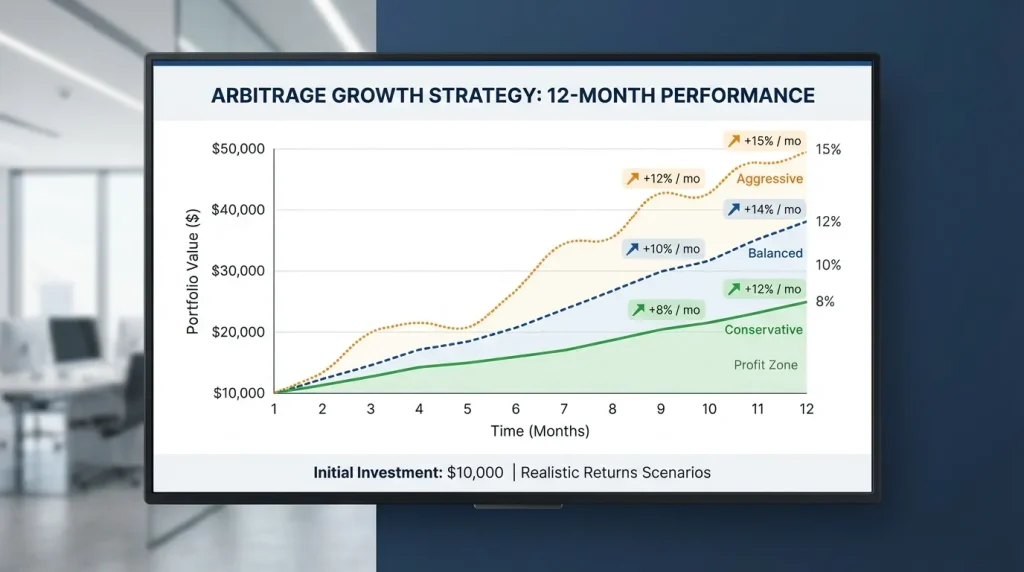
- Conservative mode (30-50% of deposit working): 3-8% per month
- Balanced mode (60-70% of deposit): 8-15% per month
- Aggressive mode (80-90% of deposit): 15-25% per month
Annual return with reinvestment: 50-150%. Professional arbitrage funds target 30-60% annually and consider this an excellent result.
Important to understand:
- These are not guarantees, but historical observations
- There are months with zero or slight negative returns (for example, during periods of extremely low volatility)
- Past performance does not guarantee future results
But unlike speculative trading, where 90% lose money, arbitrage has positive mathematical expectation: the system enters a trade only when the spread is large enough (from 3%) to cover all commissions and leave profit.
Social Proof: Who Else Is Making Money From This
Professional arbitrage funds have existed for decades in traditional markets (stocks, bonds, currencies). With the emergence of cryptocurrencies, they were the first to exploit inefficiencies between exchanges.
Examples:
- Jump Trading, DRW—the largest market-makers in crypto, earning hundreds of millions from arbitrage
- Alameda Research (before FTX collapse) generated up to 80% of profits precisely from arbitrage
- Thousands of small funds and individual traders worldwide
PrimeARB AI statistics: 93% of closed arbitrage trades have positive results thanks to careful opportunity selection (minimum 3% spread) and use of stop-losses.
Debunking Objections: Why This Works
“If it were that simple, everyone would be doing it”
Not everyone, but those who have capital, technology, and knowledge. Manual arbitrage is extremely difficult: you need to register on dozens of exchanges, constantly monitor prices, react quickly. Automated systems like PrimeARB make this accessible to ordinary investors—like the emergence of robo-advisors in traditional finance.
“Isn’t this a Ponzi scheme?”
No, because:
- Your money stays in your exchange accounts, not in a “common pool”
- Profit is generated from real arbitrage, not from new participants’ contributions
- You can withdraw funds from exchanges at any time
- The system is verified through KYC and complies with AML requirements
“What if the internet disconnects during a trade?”
Stop-loss orders are placed directly on exchanges. Even with complete internet disconnection, the exchange will automatically close the position when reaching a critical loss level. Plus, you always have access to exchanges through web interface or mobile app for manual intervention.
“How much capital is needed?”
- Technical minimum: $500-1,000 (with limitations)
- Recommended start: $3,000-5,000 for comfortable operation and diversification
- Optimal: $10,000+ for full utilization of opportunities across all 8 exchanges
Start with capital whose loss you’re psychologically prepared to accept without panic.
“Is this safe?”
API keys are created without withdrawal permissions. The system requires user KYC verification to comply with international AML requirements. Trading is conducted on high-speed dedicated servers with minimal ping, ensuring reliable trade execution.
Where to Start
If the idea of systematic earnings from market structural inefficiencies resonates with you, here’s a practical plan:
Step 1: Registration and Verification
- Register on the official PrimeARB AI website
- Complete KYC verification (usually 1-2 business days)
- The system will automatically create sub-accounts on 8 partner exchanges
Step 2: Deposit
- Start with a comfortable amount ($3,000-5,000 recommended)
- Deposit funds in USDT, BTC, or ETH to the system’s single account
- Capital will automatically distribute between exchanges
Step 3: Parameter Configuration
- Choose operating mode: start with conservative (30-50% of deposit working)
- Set risk parameters: 1% per trade recommended for beginners
- Define list of traded pairs (can limit to only top assets: BTC, ETH, BNB for stability)
Step 4: Launch and Monitoring
- Activate automated trading
- First trade usually opens within 24-48 hours
- Regularly check results through unified interface (but don’t interfere emotionally!)
Step 5: Optimization
- After 2-4 weeks, analyze statistics
- With stable results, you can increase deposit utilization percentage to balanced mode (60-70%)
- Reinvest profits for compounding effect
Golden rule: Don’t expect instant enrichment. Give the system 2-3 months for a statistically significant sample of trades. Arbitrage is a marathon, not a sprint.
How to Turn Market Chaos Into Systematic Income
Price discrepancies between exchanges are not a market error, but its inevitable property. As long as dozens of independent trading platforms, different time zones, technological delays, and human emotions exist—these “gaps” will appear again and again.
Traditionally, only large funds with millions of dollars in infrastructure could exploit these opportunities. PrimeARB AI democratizes access: automation, single deposit, stop-loss protection, and no need for technical knowledge make futures arbitrage accessible to ordinary investors.
This is not a magic pill or wealth guarantee. This is a professional tool for those tired of the emotional rollercoaster of speculative trading and who want to earn from mathematics, not luck. A systematic approach, realistic expectations (8-15% per month on average), and willingness to learn—that’s what distinguishes successful arbitrageurs from gamblers.
The next step is yours. Study the materials, start with conservative mode, give the system time. The market creates opportunities every day—the only question is whether you’re ready to use them professionally.
Disclaimer: This article is for educational purposes only and does not constitute financial advice. Cryptocurrency trading involves risks. Invest only funds whose loss you are prepared to accept. Past performance does not guarantee future results.
Information about the author

As head of the PrimeARB AI platform, Nathan applies his many years of experience in financial markets and technology to create an innovative AI system for futures arbitrage. His vision is to make professional trading strategies accessible to a wide range of investors through automation and artificial intelligence.
Nathan Michaud is a recognized professional trader with over 20 years of experience trading on the NYSE and Nasdaq exchanges in the United States. Starting his trading career in 2003 as a student at the University of New Hampshire – Whittemore School of Business and Economics, Nathan quickly turned his passion for financial markets into a successful career.
