How to earn 8-15% monthly without guessing Bitcoin’s direction
Have you ever lost money trying to catch the “bottom” of a falling Bitcoin? Or sold an asset in panic, only to watch it skyrocket the next day? If so—you’re not alone. 95% of retail traders lose money in the cryptocurrency market because they’re trying to play a game where the rules are written against them.
But what if there was a way to profit from cryptocurrencies without predicting the future? Where it doesn’t matter if Bitcoin rises to $100,000 or falls to $20,000? Where you sleep peacefully while a bot works for you 24/7? Welcome to the world of futures arbitrage—a strategy that professional funds have been using for decades, now accessible to private investors.
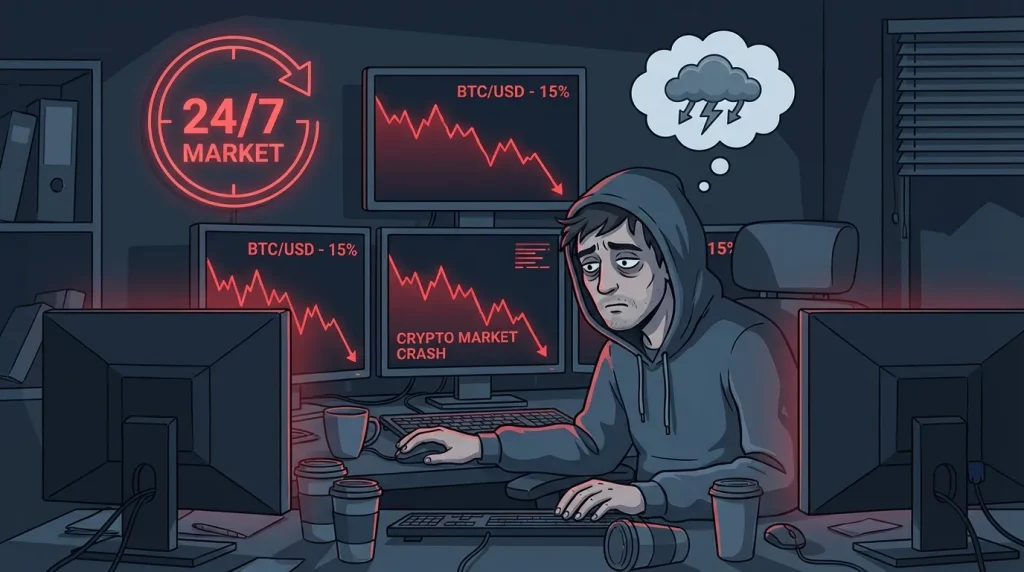
The Problem with Speculative Trading: A Game You’re Designed to Lose
Let’s be honest: trading cryptocurrencies looks simple, but it isn’t. News headlines are filled with stories of millions earned from “correctly” buying Dogecoin or Solana. But they remain silent about thousands of people who lost their savings on those same assets.
Three harsh truths about speculative trading:
- You’re competing against machines While you manually analyze charts, algorithmic trading bots from major funds execute thousands of trades per second, using advanced analytics and liquidity access you can only dream of. Your chance to “beat” them is like trying to outrace a Ferrari on a bicycle.
- Emotions destroy capital Saw Bitcoin at $68,000 and thought, “I’ll buy when it drops to $60,000”? Then it surged to $73,000, you bought in FOMO (fear of missing out), and it crashed to $50,000? Market psychology forces you to buy at peaks and sell at bottoms—the exact opposite of a profitable strategy.
- The market works against you 24/7 Cryptocurrency exchanges never sleep. While you’re resting, the market can reverse 15%. You wake up—and your stop-loss triggered at the worst spot, or your position got liquidated. Constant anxiety isn’t a price worth paying for potential profits.
The result? Most retail traders operate at a loss, fueling the profits of professional players. But there’s an alternative.
What is Futures Arbitrage—And Why It Changes the Game
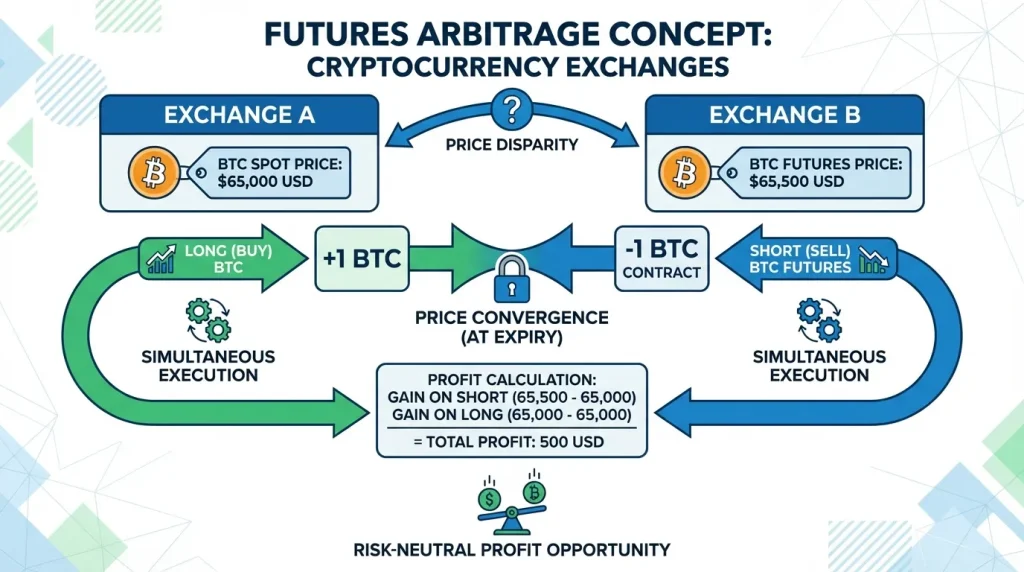
Imagine you walked into an electronics store and saw an iPhone for $800. Across the street, another store sells the same iPhone for $900. You buy from the first, sell to the second—pocket $100 risk-free. That’s arbitrage in its purest form.
In cryptocurrencies, the same principle applies, except instead of stores—there are exchanges. Bitcoin on Binance costs $50,000, on Bybit—$51,500. Futures arbitrage allows you to simultaneously buy cheaper and sell higher, profiting from the difference.
How does it work technically?
Step 1: Opening positions The system finds a price difference (spread) between exchanges. Let’s say ZEC/USDT on Bybit trades at $30, on Bitget—at $32.10 (7% spread).
- On Bybit, open a Long (buy futures) at $30
- On Bitget, open a Short (sell futures) at $32.10
Step 2: Waiting for convergence The market is a self-correcting mechanism. Other arbitrageurs, market maker algorithms, and natural supply/demand equalize prices. After several hours/days, prices converge to a common level, say $31 on both exchanges.
Step 3: Closing positions and locking in profit
- On Bybit, close Long: bought at $30, sold at $31 → +$1
- On Bitget, close Short: sold at $32.10, bought at $31 → +$1.10
- Total profit: $2.10 on $30 capital ≈ 7%
- Minus exchange fees (~0.20%) → net profit ~6.8%
Key point: It doesn’t matter if ZEC price subsequently fell to $25 or soared to $40. You earned from the difference between exchanges, not from market direction.

Why do these price differences even exist?
This is the question all beginners ask. If arbitrage is so obvious, why don’t spreads disappear instantly?
Reason 1: Technical delays Prices update with micro-delays. Binance processed a large order 0.2 seconds faster than Gate.io —and voilà, a spread appears.
Reason 2: Regional differences in liquidity Major exchanges (Binance, Bybit) have millions of users, smaller ones (MEXC, BingX)—fewer. One large order on a small exchange moves the price more significantly.
Reason 3: Volatility When Bitcoin flies $2,000 in 5 minutes, exchanges can’t synchronize instantly. Spreads of 3-7% emerge, lasting for hours.
Reason 4: Withdrawal restrictions and fees If an exchange has difficult withdrawals (high fees, lengthy verification), there may be a price “discount” there. Arbitrageurs account for this.
Important to understand: spreads occur constantly. Professional funds have been profiting from arbitrage for decades because markets are inherently imperfect. As long as multiple exchanges and human psychology exist—arbitrage will work.
PrimeARB AI: How Professional Arbitrage Became Accessible to Private Investors
Previously, arbitrage required:
✗ Manually register on 8 exchanges
✗ Pass KYC on each
✗ Create and configure API keys
✗ Manually distribute capital
✗ Write code for price screeners
✗ Sit in front of screens 24/7
This consumed hundreds of hours and required technical skills. PrimeARB AI automated all these stages.

How the system works: from registration to first profit
- Single deposit instead of 8 accounts You deposit funds into one account in the PrimeARB AI system (minimum $500-1000, recommended $3000-5000). The platform automatically creates sub-accounts on Binance, Bybit, MEXC, Gate.io, Bitget, BingX, OKX, WEEX and distributes capital optimally.
- Automatic screener searches for opportunities The algorithm monitors futures contract prices across all 8 exchanges every second. It filters pairs by criteria:
- Minimum spread: 3% (covers fees + profit)
- Liquidity: sufficient volume for entry without slippage
- Historical stability: pair isn’t prone to delisting or freezing
- High-speed execution via API When an opportunity is found, the system instantly (latency <100 milliseconds) opens opposite positions on two exchanges. This is critical—a delay of even 5 seconds can mean the spread has collapsed.
- Stop-loss protection at exchange level What if the internet disconnects? Or an exchange glitches? Stop-loss orders are set directly on exchanges, not in the software. Even if connection to PrimeARB AI is lost, the exchange automatically closes the position when the loss level is reached (~1% of position).
- Automatic closing upon price convergence The system monitors spread in real-time. When the price difference shrinks to 0.3-0.5%, positions are closed, profit is locked. Capital is freed for new opportunities.
Three operating modes: choose your risk level
Conservative (30-50% deposit in use)
- Expected return: 3-8% monthly
- For whom: beginners, cautious investors
- Advantages: large reserve for margin calls, psychological comfort
- Disadvantages: incomplete capital utilization
Balanced (60-70% deposit) — RECOMMENDED
- Expected return: 8-15% monthly
- For whom: majority of users
- Advantages: balance of return and safety, 3-5 simultaneous positions
- Optimal start for understanding the strategy
Aggressive (80-90% deposit)
- Expected return: 15-25% monthly
- For whom: experienced users ready for drawdowns
- Advantages: maximum capital efficiency
- Risks: smaller reserve, requires monitoring
Critically important: These aren’t guarantees, but statistics based on historical data. Professional arbitrage funds target 30-60% annually. If someone promises “10% daily”—it’s fraud.
Security: Why Your Funds Remain Yours
This is the first question any reasonable investor should ask: “Who controls my money?”
PrimeARB AI security architecture:
- Funds remain on exchanges PrimeARB AI does not store your cryptocurrencies. Money sits in your sub-accounts on Binance, Bybit, and other exchanges—platforms with billions in turnover and strict regulation.
- API keys without withdrawal rights The system uses API keys with limited permissions:
✓ Trading (opening/closing positions)
✓ Balance reading
✗ Withdrawal PROHIBITED
Even if someone gains access to an API key, they cannot steal funds.
- KYC verification Registration requires identity verification (passport, selfie, address). This protects against fraudsters and complies with international AML/KYC requirements.
- IP whitelist and two-factor authentication Additional protection layers: access only from approved IP addresses, mandatory 2FA on login.
Main principle: You can always revoke API keys and manually close positions through the exchange’s web interface. Control remains with you.
Social Proof: Numbers That Speak for Themselves
93% of trades close with positive results—this isn’t marketing, but system performance statistics. How is this possible?
Example of a real trade:
Pair: ZEC/USDT
Exchanges: Bybit (Long) vs Bitget (Short)
Initial spread: 7% ($30 vs $32.10)
Result after 48 hours:
- Bybit: +$210 (price rose from $30 to $37)
- Bitget: -$57 (Short position at loss during price rise)
- Net profit: $153 (210 – 57)
Notice: The asset price rose 23%, but the arbitrageur profited regardless of direction. Had the price fallen, profit would have come from the other side (Short on Bitget in profit, Long on Bybit at loss, but spread still closed).
Why 7% unsuccessful trades?
Arbitrage isn’t magic. Sometimes:
- An exchange halts trading due to technical issues
- Spread doesn’t converge but widens (stop-loss triggers)
- Extreme volatility creates slippage
Positive mathematical expectation means: if you conduct 100 trades, 93 bring profit (average +0.5% each), 7—loss (average -0.8% each). Result: (93 × 0.5%) + (7 × -0.8%) = +41% over 100 trades. This is simplified math, but the principle is valid.
Your First Steps in Arbitrage
If you’re tired of the emotional roller coaster of speculative trading and want to try a strategy used by professionals, here’s a concrete plan:
Step 1: Education (you’re already here)
Congratulations—you’ve read this article. Now you understand the difference between speculation and arbitrage better than 95% of retail traders.
Step 2: Register with PrimeARB AI
Visit the official PrimeARB AI website. Complete the registration form (email, strong password). Activate your account via email.
Step 3: KYC verification
Upload passport/ID, take a selfie, confirm address (utility bill). Processing takes from several hours to 1-2 business days.
Step 4: Deposit
Fund your account with cryptocurrency (USDT, BTC, ETH) or via bank transfer. Start with $3,000-5,000 for optimal experience. The system automatically creates sub-accounts on exchanges.
Step 5: Configure parameters
Choose operating mode: balanced (60-70% deposit)—best start. Minimum spread: 3% (don’t change without understanding). Activate trading.
Step 6: Monitoring and learning
For the first 2-4 weeks, check the system daily. Study which pairs are traded, how quickly positions close. After this, you can switch to weekly monitoring.
Step 7 (optional): Scaling
If after a month results meet expectations, you can:
- Increase deposit
- Switch to aggressive mode (for experienced users)
- Reinvest profits for compounding
A Game Where You Calculate, Not Guess
Speculative trading is gambling where you bet against professionals with better tools, capital, and information. 95% lose not because they’re foolish, but because they’re playing a game with negative mathematical expectation.
Arbitrage is the opposite. It’s not predicting the future, but exploiting current market inefficiencies. Futures arbitrage has positive mathematical expectation: if the system finds a 3% spread and fees are 0.2%, each trade is statistically profitable.
PrimeARB AI democratized access to this strategy. What previously required a team of programmers and hundreds of setup hours is now available in a few clicks. You don’t become a professional trader—you hire a robot that works like a professional trader.
The key question isn’t “Will Bitcoin rise?” but “Am I ready to use a systematic approach instead of emotional decisions?” If yes—arbitrage could be the strategy that finally makes cryptocurrencies a source of stable income rather than stress.
Remember: This isn’t a guarantee of wealth. It’s a tool that, when used wisely, provides a statistical edge. Start with conservative mode, learn, adapt. And let the market move wherever it wants—you’re profiting from its imperfection.
Disclaimer: This article is for educational purposes only and is not financial advice. Cryptocurrency trading and arbitrage strategies carry the risk of capital loss. Always conduct your own research and consult with a financial advisor before making investment decisions. Past performance does not guarantee future returns.
Information about the author

As head of the PrimeARB AI platform, Nathan applies his many years of experience in financial markets and technology to create an innovative AI system for futures arbitrage. His vision is to make professional trading strategies accessible to a wide range of investors through automation and artificial intelligence.
Nathan Michaud is a recognized professional trader with over 20 years of experience trading on the NYSE and Nasdaq exchanges in the United States. Starting his trading career in 2003 as a student at the University of New Hampshire – Whittemore School of Business and Economics, Nathan quickly turned his passion for financial markets into a successful career.

