
Is cryptocurrency making money for you — or are you making money for those who sell it to you? Every month, thousands of newcomers lose their capital to “super-profitable” schemes promising 50–100% returns in a week. But a different approach exists — quietly, stably, and mathematically: futures arbitrage. No promises of the moon. Just mathematics. Today we’ll honestly break down what separates a real capital growth tool from a speculative trap.
Why Crypto Beginners Lose Money: The Most Common Pain Points
Imagine: you hear about cryptocurrency for the first time. You read stories of people who bought Bitcoin at $5 and became millionaires. You open an exchange account, buy a coin — and it immediately drops 30%. You wait. It drops further. You panic — and sell. Two weeks later it’s back where it started.

This is called emotional trading, and it destroys the accounts of most beginners.
Then a Telegram channel promises you “guaranteed 10% per day” through a smart bot. You deposit $1,000. For the first three days you see profit in your personal dashboard. You add more. On the fourth day — the website is down. The money is gone.
This is called a financial pyramid, and there are thousands of them in crypto.
The problem isn’t cryptocurrency itself. The problem is that most people don’t know:
- That markets are unpredictable — and you don’t need to guess price direction
- That automated systems exist for real earnings, not just hype
- That there are strategies which profit regardless of whether the market goes up or down
One of those strategies is futures arbitrage. And that’s exactly what PrimeARB AI is built on.
Educational Block: What Is Arbitrage and Why Does It Work
Let’s start from the very beginning, without jargon.
Where the Profit Comes From
Imagine: the grocery store near your house sells milk for $1.20, while the shop in the next neighbourhood charges $1.60. If you buy milk in bulk from the first and sell it to the second, you profit from the difference. That’s arbitrage — earning from price inefficiency, not from predicting the future.
The same thing happens in crypto: the same asset trades at slightly different prices on different exchanges. ZEC/USDT on Bybit — one price, on Bitget — another. This difference is called a spread.
Why do spreads exist at all?
- Different liquidity pools. Binance has millions of traders; MEXC has fewer. A single large order on a smaller exchange can move the price more sharply.
- Technical delays. When breaking news drops, exchanges react at different speeds. In those seconds, the spread opens up.
- Regional demand. During a panic in Asian markets, local exchanges have more sellers — pushing prices lower there.
- Market-maker algorithms operate independently on each platform, constantly creating temporary price divergences.
These windows close fast — professionals are constantly arbitraging them away. But they open again and again, creating an endless stream of opportunities.
How Futures Arbitrage Neutralises Market Risk
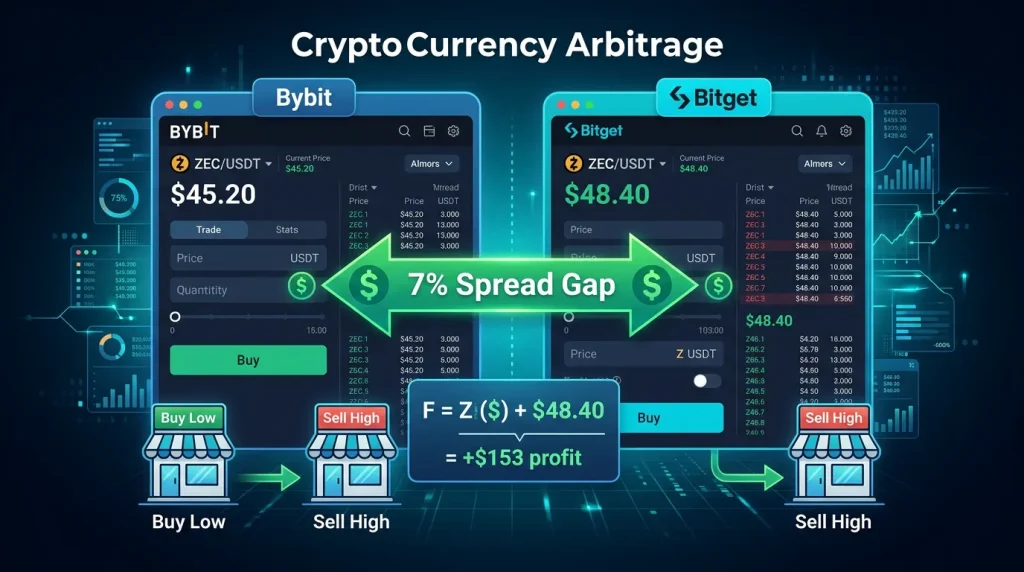
The key word here is futures. Unlike simply buying cryptocurrency, futures arbitrage opens two opposing positions simultaneously: a long (buy) on one exchange and a short (sell) on another.
A real example from live trading:
The spread on the ZEC/USDT pair between Bybit and Bitget reached 7%. The system opened:
- Long on Bybit (betting on price increase)
- Short on Bitget (betting on price decrease)
What happened next didn’t matter. Whether the coin rose or fell, the positions cancelled out any directional market risk. The only thing that mattered: the prices converged. Result:
- Bybit: +$210
- Bitget: −$57
- Net profit: $153 from a single trade
This is why arbitrage is called a market-neutral strategy. You don’t need to guess where Bitcoin is headed. Whether it rises or falls — you earn only from the prices on two exchanges moving closer together.
PrimeARB AI: How It Works in Practice

In theory, arbitrage is available to everyone. In practice, it’s a nightmare:
- You need to register on 8 exchanges and complete verification on each
- Set up API keys on every platform individually
- Monitor prices 24/7 in real time
- Open two trades simultaneously in fractions of a second (otherwise the spread disappears)
- Manage capital allocation across exchanges
- Track fees, liquidations, and stop-losses
PrimeARB AI automates this entire process. Here’s how it works, step by step:
1. Single Deposit — No Need to Register on 8 Exchanges
This is the main simplification that makes the platform accessible to beginners. You deposit funds once into the PrimeARB AI system. The platform automatically creates sub-accounts on all 8 supported exchanges:
Binance · Bybit · MEXC · Gate.io · Bitget · BingX · OKX · WEEX
You don’t need to go through KYC eight times, set up API keys manually, or distribute capital by hand. The system handles all of this for you. One personal dashboard — full control.
2. The Screener Scans for Opportunities in Real Time
Every second, the automated screener pulls data via API from all 8 exchanges and calculates spreads across hundreds of trading pairs. To enter a trade, the system applies strict filters:
- Minimum spread: 3% or above (to cover fees and ensure profit)
- Sufficient liquidity (daily pair volume over $10 million)
- Order book depth (no risk of significant slippage)
- Historical spread convergence data
A signal is only generated when all conditions are met simultaneously.
3. High-Speed Execution via API
Once a signal is received, the system places orders on both exchanges simultaneously through dedicated servers with minimal latency. Response time: under 100 milliseconds. By comparison, manually placing a trade takes 5–15 seconds — by which time the spread may already be gone.
That’s why arbitrage cannot be done manually with competitive results. It’s like picking up coins off the ground — but while you’re bending down, a robot does it 100 times faster.
4. Automatic Position Closing
The system continuously monitors when the spread closes — that is, when prices on the two exchanges converge. When that moment arrives, both orders close automatically: the profit is locked in.
What if the spread moves against you? That’s what stop-losses are for — pre-set directly on the exchanges. Even if the internet connection drops or the server is temporarily unavailable, the stop orders are already live on the exchange and protect your capital automatically.
5. Security: Your Money Stays With You
This point is critical — especially for anyone who has already encountered fraudsters.
PrimeARB AI does not hold your funds. All money stays in your personal exchange accounts (sub-accounts). The system operates solely through API keys with no withdrawal permissions — meaning the platform physically cannot withdraw your funds, even in theory. You can revoke the API key at any time and immediately stop all trading activity.
Realistic Returns: Numbers Without Sugarcoating
Professional arbitrage funds target 30–60% annually. That’s the benchmark for understanding the strategy’s potential.
PrimeARB AI offers three operating modes:
| Mode | Capital Deployed | Expected Monthly Return |
| Conservative | 30–50% | 3–8% per month |
| Balanced | 60–70% | 8–15% per month |
| Aggressive | 80–90% | 15–25% per month |
With profit reinvestment, annual results can reach 50–150% — but this is a projection, not a guarantee.
A note on fees: every arbitrage setup involves 4 transactions (opening and closing two positions). At a taker rate of 0.05%, the total fees amount to 0.20% per trade. The system only selects spreads where the potential profit meaningfully exceeds these costs — which is exactly why the minimum entry threshold is set at 3%.
Platform statistics: 93% of trades close with a positive result. This doesn’t mean there are zero losses — some positions do close at a stop-loss. But the expected value of the overall series of trades is positive.
PrimeARB AI vs. “Immediate Growth”: An Honest Comparison

This is where the central question of this article becomes critical: how do you tell a legitimate tool from yet another get-rich-quick scheme?
Let’s look at the key differences across the criteria that actually matter to an investor:
Transparency of the Mechanism
“Fast growth” schemes operate on a “trust us — we trade for you” model. No explanation of how returns are actually generated. Profits “appear” in your dashboard, but when you try to withdraw, technical problems arise — or you’re asked to pay a “tax” first.
PrimeARB AI uses a publicly documented, mathematically grounded arbitrage strategy that the world’s largest quantitative funds have employed for decades. The profit mechanism is clear and verifiable: you see every trade, every exchange, every result.
Where the Money Comes From
Pyramids and hype schemes pay “returns” using funds from new investors. This is a mathematically finite structure — it inevitably collapses when the inflow of new money stops.
Arbitrage earns from real market inefficiency — price gaps between exchanges. This is an objective economic phenomenon that exists independently of the number of platform users.
Where Your Money Sits
In a “fast growth” scheme, you hand over your money to the operator. You see a “balance” on the website, but it’s just a number in the company’s database.
In PrimeARB AI, your funds remain in your exchange accounts (Binance, Bybit, and others). The system only manages trading through API. At any point, you can log directly into the exchange and withdraw your money.
Promises vs. Realistic Projections
“Immediate Growth” sounds like: “We guarantee 10% per day!”, “Triple your money in a month”, “Zero risk, 100% success rate.”
PrimeARB AI sounds like: “8–15% per month in balanced mode, 93% of trades successful, some positions close at stop-loss, past results do not guarantee future performance.”
Notice: honesty about risks is a sign of a legitimate product, not a weakness. Anyone promising “guaranteed returns” in crypto is either lying or doesn’t understand what they’re talking about.
Who Is PrimeARB AI Right For
This tool is not for everyone — and that’s also honesty.
It’s a good fit if you:
- Want passive income without daily market monitoring
- Are prepared to invest at least $3,000–5,000 for a medium-term period
- Understand that 8–15% per month is a realistic, not a fantasy, target
- Value transparency and control over your own funds
It’s not a good fit if you:
- Are looking for 100% returns in a week
- Are not prepared for possible drawdowns (10–15% of deposit in a rough period)
- Are about to invest your last savings without a financial safety net
First Steps: How to Get Started Without the Stress
If you’ve read this far and are ready to try — here’s the minimum path to your first trade:
- Registration on the PrimeARB AI website (3–5 minutes)
- KYC verification — upload documents, confirm identity (processing: a few hours to 1–2 business days)
- Deposit in cryptocurrency USDT/USDC to the system’s unified account
- Choose a mode — we recommend starting with Conservative (30–50% of deposit deployed): minimal risk, time to understand how the system works
- Launch — the system automatically creates sub-accounts, distributes capital, and begins scanning for spreads
Within 24–48 hours you’ll see the first closed positions in your dashboard. All operations are fully transparent: timestamp, exchanges, amounts, result.
Real Investments Are Boring
There’s a paradox in finance: the best investments are boring. No adrenaline from guessing directions, no late-night panic-selling, no “signals”, no promises of the moon.
Just mathematics. Just statistics. Just the systematic collection of spreads, day after day, trade after trade.
Futures arbitrage through PrimeARB AI is not a story about becoming rich in a month. It’s a story about capital working steadily while you get on with your life. 8–15% per month, compounded over a year, turns into 100–150%. That’s not magic — it’s compound interest and market inefficiency doing their job.
The next time someone offers you “guaranteed growth” — ask one question: “Where exactly does the money for payouts come from?” If there’s no clear answer — it’s hype. If the answer is “from the price difference between exchanges that you can verify yourself” — that conversation is worth continuing.
All return figures represent historical results and projections, not a guarantee of future performance. Investments in cryptocurrencies carry risk. Make decisions carefully and only invest funds you can afford to lose.
Information about the author

As head of the PrimeARB AI platform, Nathan applies his many years of experience in financial markets and technology to create an innovative AI system for futures arbitrage. His vision is to make professional trading strategies accessible to a wide range of investors through automation and artificial intelligence.
Nathan Michaud is a recognized professional trader with over 20 years of experience trading on the NYSE and Nasdaq exchanges in the United States. Starting his trading career in 2003 as a student at the University of New Hampshire – Whittemore School of Business and Economics, Nathan quickly turned his passion for financial markets into a successful career.
