
Are You Tired of Guessing Which Way the Market Will Move?
Most people entering the crypto world for the first time ask the same question: “How do I earn consistently without turning my financial life into a casino?” You buy Bitcoin — it drops. You sell — it pumps. Sound familiar?
There are two fundamentally different approaches to automated crypto trading. One works instead of you, placing bets on price rises or falls. The other earns money regardless of whether the market is soaring or sinking. In this article, we’ll take an honest look at both — and explain why the difference between them is fundamental.
The Problem: Why Classic Trading Destroys Your Nerves (and Your Balance)

Picture a typical scenario: you open a long position on ETH after studying the charts and reading some analysis. You go to sleep. Overnight, a headline drops out of China — and in the morning you wake up to a 25% loss on your balance.
This isn’t an exception — it’s the norm on a volatile market. Here’s what every beginner trader faces:
Emotional burnout. Watching price charts 24/7 is physically impossible. But it’s precisely at night, on weekends, and during holidays that the market “loves” to make sharp moves. You either don’t sleep — or you miss the critical moments.
Errors in manual trading. The human brain makes decisions under the pressure of emotions — fear and greed. Research consistently shows that the majority of retail traders underperform the market over the long term.
The complexity of setting up arbitrage manually. Arbitrage is one of the most effective strategies available — but doing it manually is nearly impossible: too many exchanges, prices moving too fast, too many technical details to manage simultaneously.
Dependence on market direction. Every speculative strategy requires a prediction: will the price go up or down? Even professionals get it wrong. Even algorithms get it wrong.
That’s exactly why smart investors seek out strategies that do not depend on market direction.
Educational Block: What Is Futures Arbitrage and Why Does It Work?
A Simple Analogy to Start With
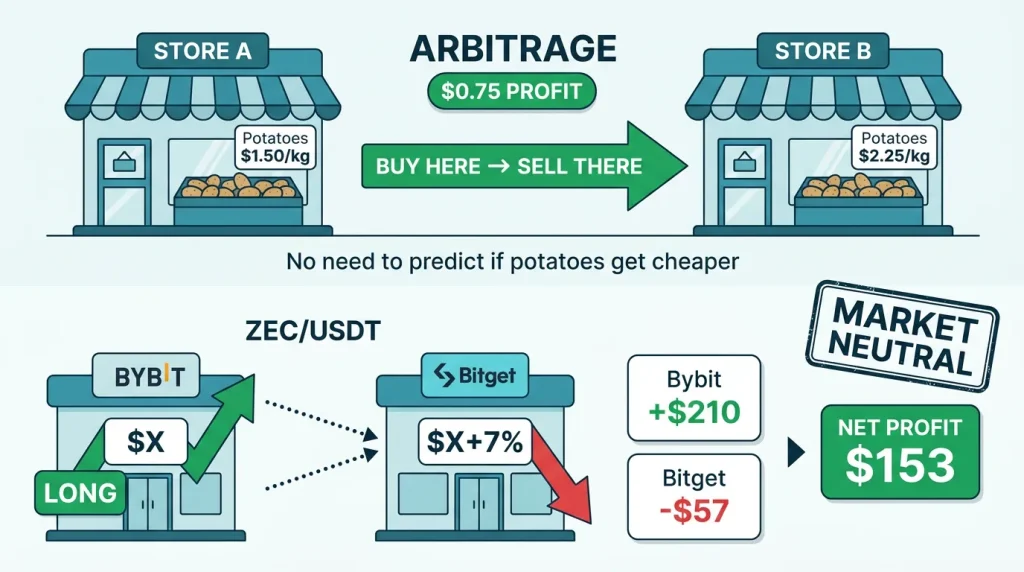
Imagine you live in a city where one supermarket sells potatoes for $1.50 per kilo, and another sells them for $2.25. You buy in bulk from the first store and sell at the second. As long as that price gap exists — you profit. You don’t need to predict whether potatoes will become more or less expensive. You only care about the price difference right here, right now.
Futures arbitrage in cryptocurrency works on exactly the same principle — except instead of potatoes, you have Bitcoin, Ethereum, and hundreds of other coins, and instead of stores, you have crypto exchanges.
Why Do Price Differences Between Exchanges Exist?
You’d think that in the age of instant internet, the price of a single asset would be identical everywhere. But it’s not. Here’s why:
- Technical latency. Exchanges update prices with micro-delays. Binance and Bybit run on different servers, different data centers, with different traffic loads. During high volatility, this difference can reach several percent.
- Differences in liquidity. Millions of participants trade on Binance — prices stabilize quickly. On smaller exchanges, a single large order can move the price by 2–5%.
- Regional demand. During moments of panic or euphoria, different parts of the world react differently. Asian traders may sell more aggressively while European traders are just waking up.
- Algorithmic behavior. Market-maker algorithms operate independently on each exchange, creating temporary price divergences.
These divergences are short-lived, but they constantly reappear. The market is never perfectly synchronized.
What Does an Arbitrage Trade Look Like in Practice?
A real example from the system’s trading history: the ZEC/USDT pair on Bybit and Bitget. During a period of strong decorrelation, the spread reached 7%. The system simultaneously opened:
- A long (buy) position on Bybit — betting on price increase
- A short (sell) position on Bitget — betting on price decrease
When the prices on both exchanges converged, both positions were automatically closed:
- Bybit: profit of +$210
- Bitget: loss of −$57
- Net profit: $153 from a single trade
Crucially: it didn’t matter which direction ZEC’s price moved — up or down. The money was made on the convergence of the price gap between two exchanges.
How Does This Differ From Regular Trading?
| Parameter | Speculative Trading | Futures Arbitrage |
| Market dependency | High | Neutral |
| Price forecasting | Required | Not required |
| Risk level | High | Controlled |
| Emotional impact | Strong | Minimal |
| Operates 24/7 | Difficult | Automatically |
Immediate Edge vs PrimeARB AI: What’s the Fundamental Difference?
What Is Immediate Edge?
Immediate Edge is a platform that positions itself as an “automated trading robot” for cryptocurrencies. Its core logic: the algorithm predicts the direction of price movement and opens positions in anticipation of an asset rising or falling.
In other words, Immediate Edge is automated speculation. The robot places bets on your behalf. Quickly and without your involvement. If the algorithm guesses correctly — you profit. If not — you lose.
In theory, it sounds reasonable. In practice, serious questions arise:
- How do you verify that the algorithm is actually “predicting” price — and not simply trading randomly?
- Who is accountable for losses if the forecast turns out to be wrong?
- Why doesn’t the platform publish real, independently verified performance statistics?
An additional risk worth noting: your funds may be held on a broker-partner’s accounts, not in your own personal exchange accounts. This is a fundamental security concern we’ll return to shortly.
What Is PrimeARB AI?
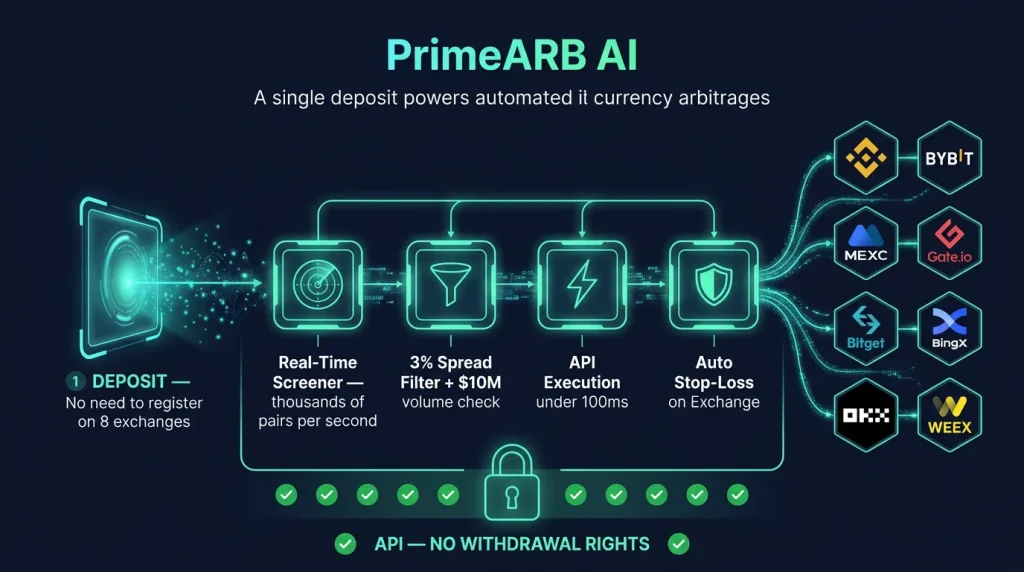
PrimeARB AI is an automated futures arbitrage platform operating across 8 exchanges: Binance, Bybit, MEXC, Gate.io, Bitget, BingX, OKX, and WEEX.
The key difference from Immediate Edge and similar platforms — PrimeARB does not predict price. The system doesn’t need to know whether Bitcoin will rise or fall. It profits from the temporary price difference between exchanges, which arises again and again for objective technical reasons.
This is a market-neutral strategy. It doesn’t matter whether the market is going up, down, or sideways — arbitrage opportunities always exist.
How PrimeARB AI Works: From Entry to Profit
Step 1: Real-Time Screener
Every second, the system monitors futures contract prices across all 8 exchanges. The screener analyzes thousands of trading pairs, searching for price divergences of 3% or more, evaluating liquidity and order book depth. All of this happens automatically, with no human involvement.
Step 2: Signal Analysis and Filtering
Not every spread is a viable trading opportunity. The system additionally checks trading volume (minimum $10 million per day on each exchange), the historical stability of price convergence, and other parameters. Only when all conditions are met is a trading signal generated.
Step 3: Instant Execution via API
Trade orders are executed on high-speed dedicated servers with minimal latency to the exchanges. Response time: under 100 milliseconds. By the time a human even notices an opportunity, the robot has already opened both positions.
Step 4: Automatic Closing Upon Convergence
As soon as the prices on both exchanges converge and the spread is captured — positions are closed automatically. If the spread doesn’t close within the acceptable parameters — a stop-loss triggers, limiting losses.
One Deposit Instead of Registering on 8 Exchanges
One of the most frequent questions from beginners: “Do I need to register on all 8 exchanges myself?”
The answer is no. This is one of PrimeARB AI’s key technical advantages.
You deposit funds into a single account within the system. After successful identity verification (KYC), the platform automatically creates sub-accounts on partner exchanges, registers them in your name, and configures the internal API keys. Your capital is automatically distributed across exchanges in an optimal manner.
You don’t need to:
- ❌ Register on 8 exchanges yourself
- ❌ Manually create and configure API keys
- ❌ Manually transfer capital between exchanges
- ❌ Monitor balances on each platform separately
You manage everything through PrimeARB AI’s single unified interface.
Security: Where Is Your Money?
This is arguably the most important question when choosing any automated trading platform.
With Immediate Edge and similar platforms: funds are often transferred to a broker-partner who trades them on your behalf. You lose direct control over your assets.
With PrimeARB AI: your funds remain in exchange sub-accounts registered in your name. The system operates exclusively through API keys with no withdrawal permissions.
What this means in practice:
- The platform cannot withdraw your funds — this is technically impossible
- Even if PrimeARB AI’s servers go offline, your funds remain safe on the exchanges
- You can revoke API keys and withdraw your money at any time
- An IP whitelist further restricts who can access the keys
Social Proof: Numbers, Not Promises
Here are the real performance statistics of the system:
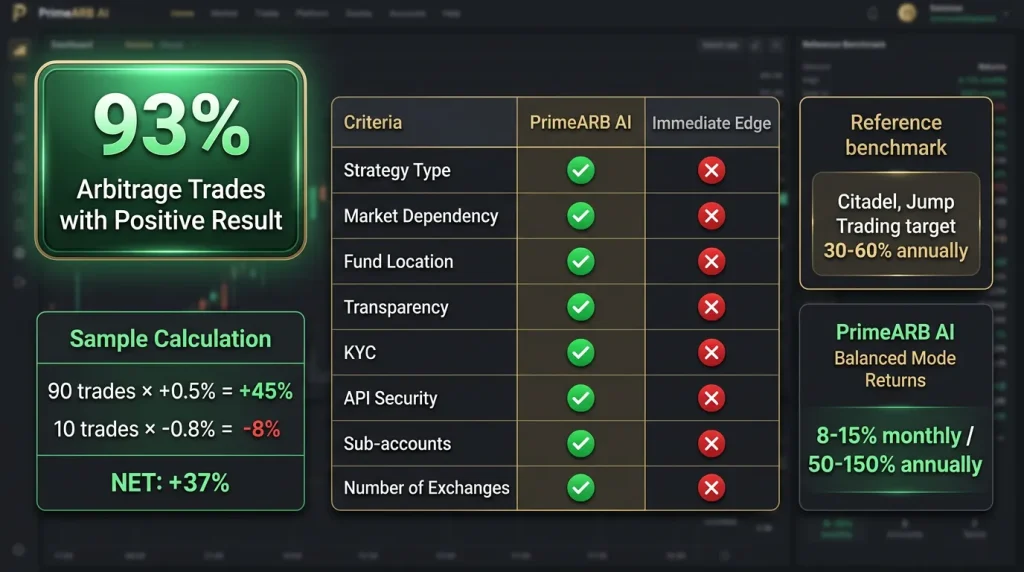
93% of arbitrage trades close with a positive mathematical expectation. This doesn’t mean every single trade is profitable — 7% of trades may require a stop-loss. But a series of 100 trades statistically delivers a positive outcome.
Sample calculation:
90 trades × (+0.5%) = +45%
10 trades × (−0.8%) = −8%
Total across 100 trades: +37% of deployed capital
Real case study — ZEC/USDT pair (Bybit/Bitget):
- Spread reached 7%
- Opened: long on Bybit + short on Bitget
- Closed when prices converged
- Result: +$153 from a single trade
For context: professional arbitrage funds (Citadel, Jump Trading, Virtu Financial) target 30–60% annually through similar market-neutral strategies. PrimeARB AI in balanced mode targets approximately 8–15% per month — which, with reinvestment, corresponds to 50–150% annually.
Important disclaimer: past results do not guarantee future performance. Arbitrage is not a risk-free instrument, though the risk is significantly lower than speculative trading.
Comparison Table: PrimeARB AI vs Immediate Edge
| Criteria | PrimeARB AI | Immediate Edge |
| Strategy type | Market-neutral arbitrage | Speculative trading |
| Market direction dependency | ❌ Independent | ✅ Fully dependent |
| Where funds are held | Your own exchange sub-accounts | Often with a broker-partner |
| Transparency | Verifiable statistics | Claimed results only |
| KYC / Verification | Mandatory | Often absent |
| API without withdrawal rights | ✅ Yes | ❓ Depends on the platform |
| Auto-creation of sub-accounts | ✅ Yes | ❌ No |
| Number of exchanges | 8 | 1–2 |
How to Get Started with PrimeARB AI: Step-by-Step
If you’ve read this far — you already understand the mechanics. Now for the practical part:
- Step 1 — Registration (3–5 minutes) Visit the official PrimeARB AI website. Create an account using a real email address that you check regularly. Enable two-factor authentication (2FA) immediately after signing up.
- Step 2 — Verification (KYC, 10–15 minutes) Upload a photo of your passport or ID card and take a selfie with your document. Verification takes anywhere from a few hours to 1–2 business days. This is a mandatory step for safely working with real assets.
- Step 3 — Fund Your Account Deposit funds in cryptocurrency (USDT, BTC, ETH, USDC). The recommended starting amount is $3,000–5,000. Remember: only invest funds that you can afford to keep deployed for the system’s operating period.
- Step 4 — Choose Your Trading Mode For beginners, it is recommended to start with conservative mode (30–50% of the deposit deployed, target return of 3–8% per month). As your understanding of the system deepens, you can transition to balanced mode.
- Step 5 — Launch and Monitor Once activated, the system begins operating automatically. The first trades typically appear within 24–48 hours. Your job is to periodically review the statistics in your personal dashboard. No manual intervention is required.
What Is the Fundamental Difference?
Immediate Edge and similar platforms are automated bets on the direction of the market. They may generate profit under favorable conditions, but they depend on correctly predicting price — a task that even most professionals fail at consistently.
PrimeARB AI is the systematic exploitation of market inefficiency. Not prediction, but mathematics. Not guesswork, but statistical edge.
It doesn’t matter whether Bitcoin is rising or falling — the price gap between exchanges has always existed, exists now, and will continue to exist as long as multiple independent trading platforms operate. And that means arbitrage opportunities aren’t going anywhere.
Of course, arbitrage is not a risk-free instrument. There are drawdowns. There are trades that hit stop-losses. But this is controlled, transparent risk with a positive mathematical expectation — which cannot be said about most speculative strategies.
If you’re looking for passive income from cryptocurrency without needing to predict the market — futures arbitrage through PrimeARB AI is worth exploring further.
This material is for educational purposes only and does not constitute individual investment advice. The cryptocurrency market carries risk. Only invest funds that you are prepared to deploy over the long term.
Information about the author

As head of the PrimeARB AI platform, Nathan applies his many years of experience in financial markets and technology to create an innovative AI system for futures arbitrage. His vision is to make professional trading strategies accessible to a wide range of investors through automation and artificial intelligence.
Nathan Michaud is a recognized professional trader with over 20 years of experience trading on the NYSE and Nasdaq exchanges in the United States. Starting his trading career in 2003 as a student at the University of New Hampshire – Whittemore School of Business and Economics, Nathan quickly turned his passion for financial markets into a successful career.
