Imagine being able to profit from cryptocurrency even when Bitcoin drops 30%. Sounds like fantasy? For most traders — yes. But there’s a strategy that allows professional investors to extract profits regardless of whether the market rises or crashes. This strategy is called futures arbitrage, and in 2026, it has become accessible not only to hedge funds but also to individual investors thanks to automated systems like PrimeARB AI.

The Problem Every Crypto Investor Faces
If you’ve ever traded cryptocurrency, you know this feeling. You buy Bitcoin at $48,000, confident it will rise. A week later, it’s at $42,000. You panic: sell at a loss or wait for recovery? Emotions overwhelm you, you check charts every hour, lose sleep. And when you finally sell — the price reverses and shoots up to $55,000.
Regular crypto trading is emotional torture:
- Volatility eats deposits. In one night, an asset can lose 20% due to an Elon Musk tweet or regulatory news.
- You’re trading against professionals. Algorithmic bots with direct exchange connections execute trades in milliseconds while you’re just opening a chart.
- Psychological burnout. The market operates 24/7. Even while you sleep, your portfolio can crash on news from China or the US.
- Human errors. Emotional trading, FOMO (fear of missing out), panic selling — all lead to systematic losses.
According to research, about 80% of retail traders lose money in their first year of cryptocurrency trading. The reason is simple: you’re trying to predict the future, and that’s a game with negative expected value for most participants.
But what if there’s a way to earn without guessing direction? What if you could turn cryptocurrency market chaos into systematic income by removing emotions from the equation?
What is Futures Arbitrage: Profit from Inefficiency, Not Luck
Imagine a simple situation: in one store, an iPhone costs $900, and in the neighboring store — $970 for the same model. You buy in the first store, instantly sell in the second, pocket the $70 difference. No risks, no guessing whether the iPhone will become more expensive tomorrow — you simply collect money that others didn’t notice.
Futures arbitrage works on the same principle, only in the cryptocurrency world.
How It Works Technically
Cryptocurrencies trade on dozens of exchanges simultaneously: Binance, Bybit, MEXC, Gate.io, OKX, and others. Due to differences in liquidity, technical delays, and regional peculiarities, the price of the same asset can differ between exchanges by 3-7%, especially during high volatility moments.
Real trade example:
- Bitcoin trades on Binance at $50,000
- On Bybit at the same moment — at $51,500 (3% difference)
Arbitrage strategy:
- Simultaneously buy (open LONG) on Binance at $50,000
- Simultaneously sell (open SHORT) on Bybit at $51,500
- Wait for prices to equalize (usually happens within several hours or days)
- When both exchanges show $50,750, close both positions
Result:
- Profit on Bybit: $51,500 – $50,750 = +$750
- Loss on Binance: $50,750 – $50,000 = -$750
- But since we held opposite positions, total result: collected the $1,500 spread minus fees ≈ +$1,280 net profit
Why This Works in 2026
Many ask: “If it’s so obvious, why do spreads still exist?”
Reasons for constant price discrepancies:
- Technical delays. Exchanges update prices with micro-delays. During sharp market movements, one exchange reacts 1-2 seconds faster than another.
- Regional demand differences. When Asia panics and everyone sells, Europe might be buying — creating price imbalance.
- Different liquidity. Large exchanges like Binance have more participants, more stable prices. On smaller exchanges, one large order can move the price by 2-3%.
- Growth in exchange numbers. Currently, there are over 600 crypto exchanges. The more platforms, the more inefficiencies.
- Market maker algorithms work independently on each exchange, creating temporary discrepancies that arbitrageurs (you) constantly collect.
Important to understand: professional arbitrage funds earn billions of dollars annually from this. They target 30-60% annual returns. Now this strategy is available to individual investors too.
How Arbitrage Differs from Speculation: Market Neutrality
When a regular trader buys Bitcoin, they make a directional bet: “I believe BTC will rise.” This is speculation — you’re competing with millions of other participants, trying to predict the unpredictable.
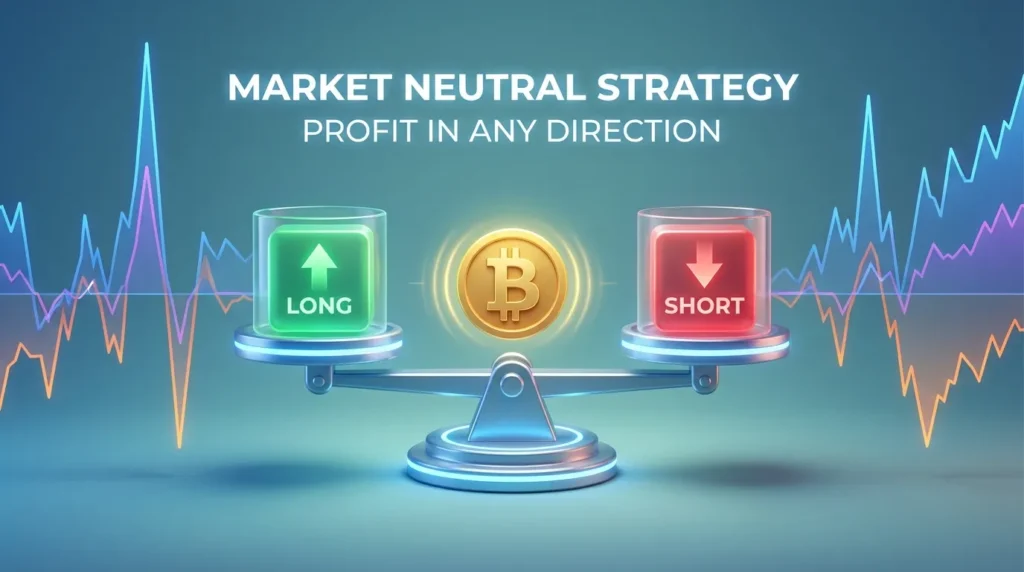
Arbitrage is a market-neutral strategy:
- You hold LONG and SHORT positions simultaneously
- If Bitcoin falls 20%, you lose on LONG but earn exactly the same on SHORT
- If it rises 30% — similarly: profit on one side compensates loss on the other
- Your earnings come from the price difference between exchanges (spread), which you collect when they equalize
It’s like picking up $100 from the ground that others didn’t notice, instead of playing casino with 50% chance of success.
Positive Expected Value
The key difference between arbitrage and speculation is mathematical profit justification.
PrimeARB AI statistics: 93% of trades close with positive results. Why? Because the system enters trades only when:
- The spread is large enough (from 3%) to cover all fees (usually 0.20%) and leave profit
- Historical data shows this asset pair consistently converges
- Liquidity on both exchanges allows quick entry and exit
Even if 7% of trades close at a loss (spread didn’t converge, stop-loss triggered), the overall result of a trade series remains positive because profitable trades outweigh unprofitable ones.

PrimeARB AI: Turning Complex Strategy into Simple Process
Professional arbitrage funds hire teams of programmers, mathematicians, maintain high-speed servers near exchanges. For an individual investor, replicating this independently is nearly impossible.
This is where automation comes in. PrimeARB AI is a software system that does all the technical work for you, leaving you only strategic decisions.
How the System Works (Without Technical Jargon)
Stage 1: Automatic Screener Every second, the system monitors futures contract prices on 8 major exchanges: Binance, Bybit, MEXC, Gate.io, Bitget, BingX, OKX, WEEX. The screener looks for pairs where the price difference is at least 3% — this is the profitability threshold considering fees.
Stage 2: Opportunity Analysis A found spread doesn’t mean automatic entry. The system evaluates:
- Liquidity (can positions be quickly opened/closed)
- Volatility (is the asset too risky)
- Convergence history (how often do prices on these exchanges equalize)
- Trading volume and order book depth
Stage 3: High-Speed Execution If all conditions are met, the system through API (direct exchange connection) instantly opens positions:
- LONG on the exchange with low price
- SHORT on the exchange with high price
- Sets stop-losses on both exchanges for protection against unforeseen events
All this happens in fractions of a second — faster than you could even open a chart.
Stage 4: Monitoring and Closing The system tracks the spread in real-time. When the difference narrows to 0.3-0.5%, positions are automatically closed, profit is locked. Usually this happens within 24-72 hours.
Main Advantage: Unified Deposit and Zero Technical Complexity
Here’s what makes PrimeARB AI revolutionary:
You DON’T need to:
- Register independently on 8 exchanges
- Pass KYC verification on each platform
- Manually create and configure API keys
- Distribute capital between exchanges manually
- Monitor balances and transfer funds
What the system does:
- You deposit funds to a unified account in PrimeARB AI
- The system automatically creates sub-accounts on exchanges on your behalf (using the company’s internal API keys)
- Your capital is distributed between exchanges optimally
- You manage everything through one simple interface
It’s like having a personal professional trader who works 24/7 without salary, vacations, or emotions.
Security: Where Your Funds Are Stored
A critically important question for any investor: “How safe is this?”
PrimeARB AI security architecture:
- Funds remain on exchanges. PrimeARB AI doesn’t store client money on its accounts. Your crypto assets are on your sub-accounts on exchanges (Binance, Bybit, etc.) — the largest regulated platforms with billion-dollar volumes.
- API keys without withdrawal rights. The system uses only keys with trading and balance reading permissions. Only the account owner can withdraw funds (you), after passing exchange verification.
- Stop-losses set on exchanges. Even if connection with the system is interrupted, the exchange will automatically close the position when critical loss is reached.
- KYC verification. Working with the system requires identity confirmation, which excludes anonymous fraudulent schemes.
- High-speed servers with minimal ping to exchanges ensure trade execution at best prices, minimizing slippage.
Realistic Expectations: How Much You Can Earn (Honestly)

Let’s be frank. This is not a get-rich-quick scheme. You won’t earn 10% per day or 300% per month — such promises only come from scammers.
Realistic futures arbitrage returns:
Conservative Mode: 3-8% Monthly
- 30-50% of deposit engaged
- Suitable for beginners and cautious investors
- Large reserve on account for margin requirements
- Minimal risk, but fewer opportunities
Balanced Mode: 8-15% Monthly ⭐ (recommended)
- 60-70% of deposit engaged
- Optimal balance between profitability and safety
- Sufficient reserve for 3-5 simultaneous positions
- Suitable for most users
Aggressive Mode: 15-25% Monthly
- 80-90% of deposit engaged
- Maximum profitability, but requires experience
- Smaller reserve — requires constant monitoring
- Not recommended for beginners
Annual returns with reinvestment: 50-150%
If taking average returns of 10% monthly and reinvesting profits, in a year $10,000 becomes $31,384 (214% growth). But this is an ideal scenario — reality is always more variable.
Real Trade Example
During strong decorrelation, the ZEC/USDT pair showed a 7% spread between Bybit and Bitget:
- LONG opened on Bybit
- SHORT opened on Bitget
- After price convergence, positions closed
Result:
- Profit on Bybit: +$210
- Loss on Bitget: -$57
- Net profit: $153 (about 5.1% per trade)
Such opportunities arise 5-10 times per week with moderate volatility, more often — during high market activity.
Addressing Common Objections
“This is too good to be true”
Understandable skepticism. But arbitrage isn’t a new strategy. Professional funds like Citadel, Jump Trading, Jane Street have been earning from arbitrage of traditional assets for decades. In cryptocurrencies, market inefficiency is higher because the industry is young, regulation is fragmented, and there are many exchanges.
This isn’t a “magic button,” but a technical strategy with mathematical justification. It’s just that previously it required resources available only to institutional players.
“What if the internet disconnects during a trade?”
Multi-level protection:
- Stop-losses are set on exchanges, not in the program — they’ll trigger even without connection
- Automatic reconnection through backup channels
- You can manually close positions through exchange web interface or mobile app
“How much capital is needed?”
- Technical minimum: $500-1,000 (with limitations)
- Recommended start: $3,000-5,000 for comfortable operation
- Optimal level: $10,000+ for full diversification
Important: start with an amount you’re ready to invest without emotional stress. Better $2,000 with a calm mind than $10,000 in panic during the first 5-7% drawdown.
“What are the risks?”
Honest about risks:
- Spread can increase instead of converging (protection: stop-loss usually at 1% loss level)
- Technical problems on exchange (trading halt, asset delisting) — that’s why 8 exchanges are used, not one
- Fees eat profits with small spreads (system enters only with spreads from 3%)
- Liquidation risks in aggressive mode (solution: conservative or balanced approach)
Main rule: this isn’t guaranteed income, but a strategy with positive expected value. There are unprofitable trades (7% by statistics), but the overall result of a series is positive.
How to Start: Four Simple Steps
If after reading you’ve decided to try, here’s a step-by-step plan:
Step 1: Registration and Verification
- Go to the official PrimeARB AI website
- Register with real email
- Complete KYC verification (passport/ID upload) — usually 1-2 business days
Step 2: Deposit
- Minimum recommended: $3,000-5,000
- Methods: cryptocurrency (USDT, BTC, ETH) — fastest
- System automatically creates sub-accounts on exchanges
Step 3: Parameter Setup
- Choose trading mode (we recommend balanced: 60-70% deposit)
- Minimum spread for entry: 3% (don’t change without experience)
- Activate trading
Step 4: Monitoring and Optimization
- First trade usually opens within 24-48 hours
- Track results through personal cabinet
- After 2-4 weeks, evaluate profitability and adjust parameters if necessary
Start conservatively: better to gradually increase aggressiveness while seeing real results than immediately risk the entire deposit.
Financial Diversification: Arbitrage’s Place in Your Portfolio
Smart investors don’t keep all eggs in one basket. Futures arbitrage is an excellent diversification tool because its returns weakly correlate with market direction.
When Bitcoin crashed 40% in 2025 after US regulatory tightening, BTC holders lost almost half their capital. Arbitrage strategies during the same period continued generating 8-12% monthly, because volatility (decline) created even more spreads between exchanges.
Portfolio allocation example:
- 40% — long-term BTC/ETH holding (bet on industry growth)
- 30% — futures arbitrage (systematic income)
- 20% — staking/DeFi (passive income)
- 10% — stablecoin reserve (for drawdowns)
Such allocation balances risks and allows earning in any market conditions.
From Chaos to System
The cryptocurrency market no longer has to be an emotional lottery. Futures arbitrage turns volatility from enemy to ally, market inefficiency — into systematic income, and complex technical strategy — into simple automated process.
Key Takeaways:
✅ Market neutrality — earn regardless of rise or fall
✅ 24/7 automation — no emotional stress
✅ Realistic returns — 8-15% monthly with balanced approach
✅ Security — funds on exchanges, API without withdrawal rights
✅ Simplicity — one deposit, system does the rest
This isn’t a guaranteed way to get rich in a month. But it’s a professional strategy with positive expected value, now available not only to hedge funds but also to individual investors.
If you’re tired of guessing market direction, want to sleep peacefully while your capital works, and are ready to approach crypto investing systematically — futures arbitrage may be that missing element in your portfolio.
Next step: explore PrimeARB AI, start with conservative mode, and give yourself 2-3 months to evaluate results. Arbitrage is a marathon, not a sprint. And in this marathon, those who replace emotions with mathematics and chaos with system win.
Information about the author

As head of the PrimeARB AI platform, Nathan applies his many years of experience in financial markets and technology to create an innovative AI system for futures arbitrage. His vision is to make professional trading strategies accessible to a wide range of investors through automation and artificial intelligence.
Nathan Michaud is a recognized professional trader with over 20 years of experience trading on the NYSE and Nasdaq exchanges in the United States. Starting his trading career in 2003 as a student at the University of New Hampshire – Whittemore School of Business and Economics, Nathan quickly turned his passion for financial markets into a successful career.

